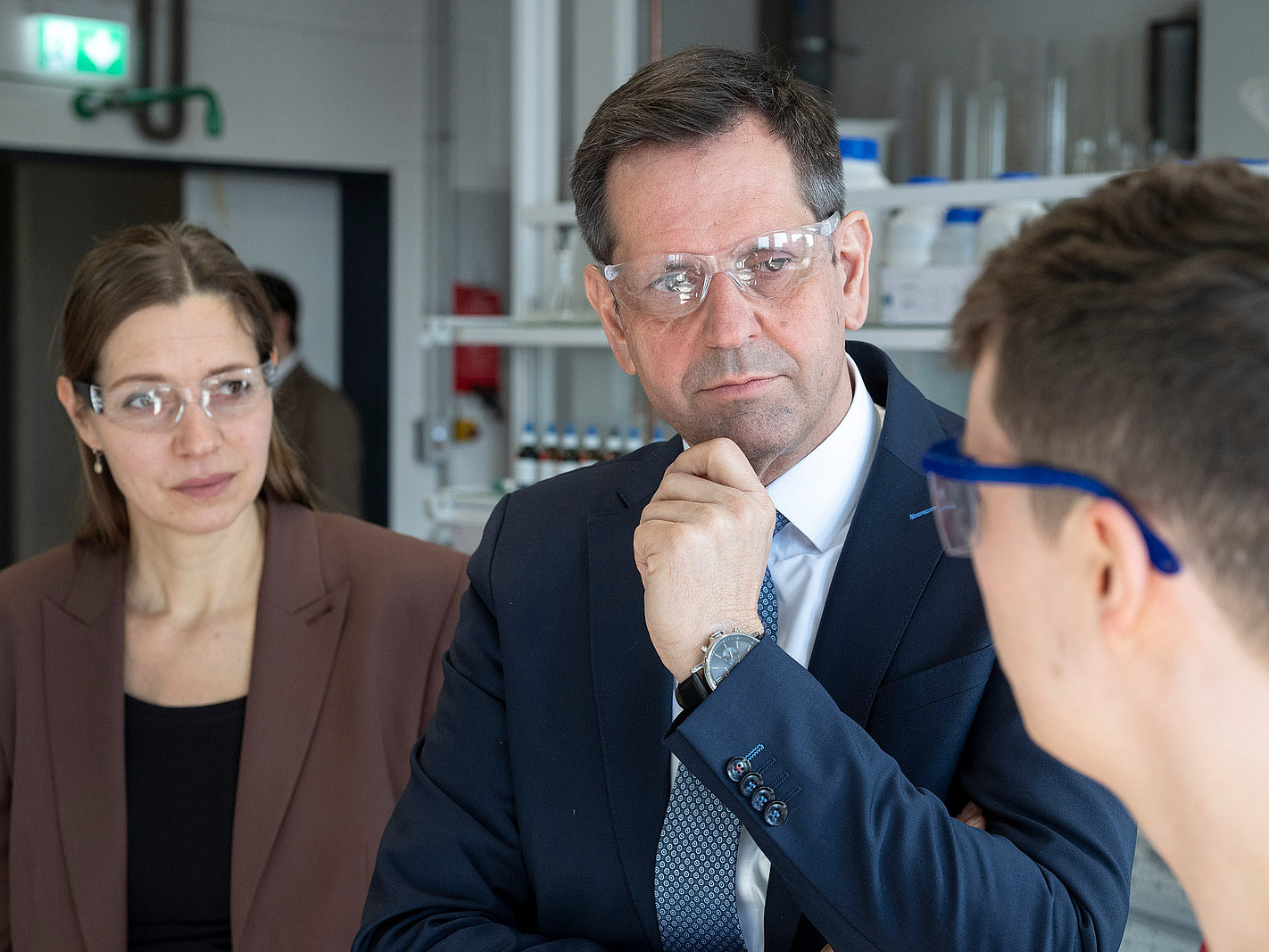
For some years now, teachers all over Germany have been asking themselves the question: How can we get pupils more interested in science? One possible answer is: through varied lessons in the laboratory. This week, Osnabrück University is hosting the LeLa annual conference, the nationwide meeting of the school laboratory community in Germany. At the opening, Lower Saxony's Minister President Olaf Lies visited the university to find out about innovative educational concepts and cutting-edge research.
"LeLa" stands for LernortLabor; the annual conference organized by the Federal Association of School Laboratories is considered one of the most important networking meetings for extracurricular learning locations in German-speaking countries.
"School laboratories are an important building block for getting young people interested in science and giving them an early insight into scientific work," emphasized Prof. Dr. Marco Beeken, didactic chemist at Osnabrück University, at the start of the conference. Events such as the LeLa annual conference help to strengthen innovative approaches to STEM education and promote the exchange between research, educational practice and society.
University President Prof. Dr. Susanne Menzel-Riedl also underlined the importance of such formats: "The promotion of STEM education and science communication is a central concern of our university. Student labs create early encounters with research and enable young people to get to know science as an exciting and socially relevant field of work."
In addition to specialist lectures and workshops, the conference program also offers impulses for modern science communication: On the evening before the conference, science communicator and YouTuber Jacob Beautemps gave insights into new formats of science communication at the Deutsche Bundesstiftung Umwelt (DBU).
Following the opening, the Minister President took the time to get a first-hand impression of research and science communication at Osnabrück University. He first visited the GreenLab_OS school laboratory run by the Chemistry Didactics working group. Here, pupils are given the opportunity to experiment independently and work on scientific issues in a practical way. The focus is on topics such as sustainability, modern chemistry and scientific working methods. The visit then led to the CellNanOS - Center for Cellular Nanoanalytics Osnabrück University research building, a central location for cutting-edge biological research at the university.
At the LeLa annual conference, around 170 participants from science, education, school laboratories and educational institutions come together for several days to discuss current developments, research findings and innovative concepts in STEM education. The program includes specialist lectures, working groups, discussion formats and a research workshop on student laboratory research.
The LeLa annual conference is part of a larger conference week at Osnabrück University, during which various events will deal with questions of STEM education and science communication. Over the next few days, further items on the conference program and exchange formats on current student laboratory research will follow.
The conference will conclude on Thursday, March 12, 2026, with the symposium "Digitality and AI in STEM education", which is expected to attract around 200 guests from science, schools and educational practice. The symposium is organized by the Teacher Training Center Chemistry Northwest and is dedicated to the question of how digital technologies and artificial intelligence can change future teaching and learning processes in the natural sciences.
Further information for the media:
Daniel Becker, Osnabrück University
School of Biology/Chemistry
E-mail: daniel.becker@uni-osnabrueck.de