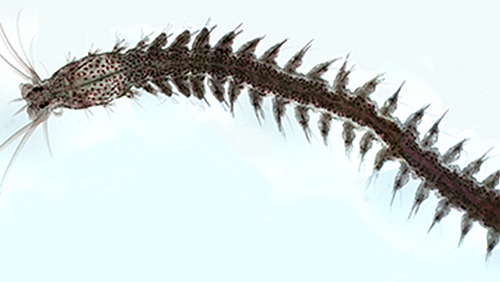
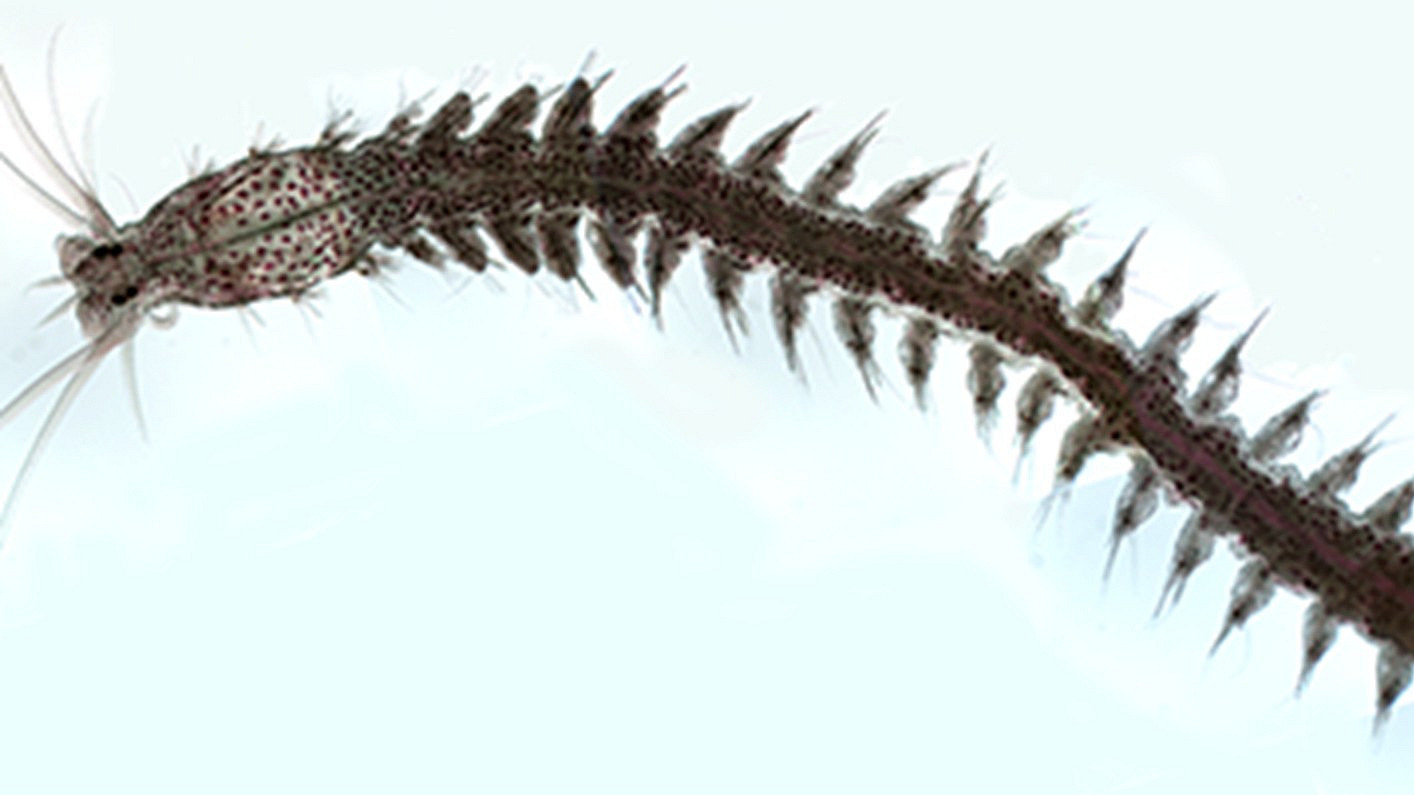
“Marine bristle worms are commonly noticed as squirming, wriggling, or writhing creatures and most people regard them with displeasure or even as disgusting, ugly or nasty if they regard them at all.”, says Günter Purschke, Zoologist at Osnabrück University. “However, if you study them more closely, they are not wretched or scary but highly interesting and sometimes even very beautiful or aesthetic organisms.”
Marine bristle worms: underrated animals
Günter Purschke's enthusiasm for the underestimated animals is clearly evident when he emphasizes: “A few species, such as Platynereis dumerilii (see image), have even become established as model organisms in evolutionary, developmental and cell biological research since many years. In diverse manners these species complement the well-known fruit fly and the nematode Caenorhabditis elegans. It has been proven that Platynereis is much more suitable for comparisons with vertebrates, the group to which humans belong.” Furthermore, polychaetes comprise an essential role in the marine food webs and ecosystems, on the one hand as consumers and on the other hand as food source for a diversity of other marine animals. “Due to the often negative impact on marine ecosystems trivializing usually called ‘global change’, distribution patterns of many taxa are subjected to dramatic changes. As a consequence, certain introduced species become pests with often fatal consequences for their new habitats whereas others are subjected to extinction.”
Multivolume overview on annelids
The recently published book on the marine animals is the fourth and last volume of an overview of the entire group of annelids. Together with Wilfried Westheide (former head of the division "Systematic Zoology" at Osnabrück University) and Markus Böggemann (University of Vechta), Günter Purschke worked on it for several years. It is the first comprehensive treatment of this group after more than 80 years and comprises contributions of more than 60 international authors and specialists of this peculiar group of animals.
Remarkable diversity
Although only comprising approximately 21,000 described species, annelids show a remarkable diversity in form and function. This diversity mirrors the plasticity of their bauplan or, more precisely, the segmentation of their body. Segmentation is known as an organization pattern comprising multiple primarily identical units, the segments. Most species are of median size and do not exceed a few centimeters in length, however their size range is considerably larger. With less than 0.5 mm body length some of the smallest metazoans belong to this group whereas the “giants” may exceed up to 3 m in length. In the marine realm, they occur in almost every habitat, from the intertidal down the deep sea and at hot hydrothermal vents, inside the sediment and in the free water column. They utilize a wide range of food sources. The vast majority of species is free-living; some live in mutualism with endosymbiotic bacteria and others may be parasites. Their reproductive biology shows every thinkable specialization and differentiation. Looking at the diversity within annelids, Purschke concludes: “We as the editors are quite sure that for every biological phenomenon you will find an example within this peculiar group of animals”.