As is typical of arthropods, the fruit fly Drosophila melanogaster does not have a closed circulatory system, but an open one. This means that unlike humans and other vertebrates, its body is not traversed by blood vessels. Instead, their body fluid, the so-called hemolymph, flows directly around their organs.
A heart beats in the fly's body too
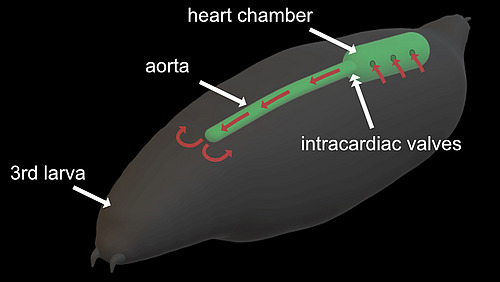
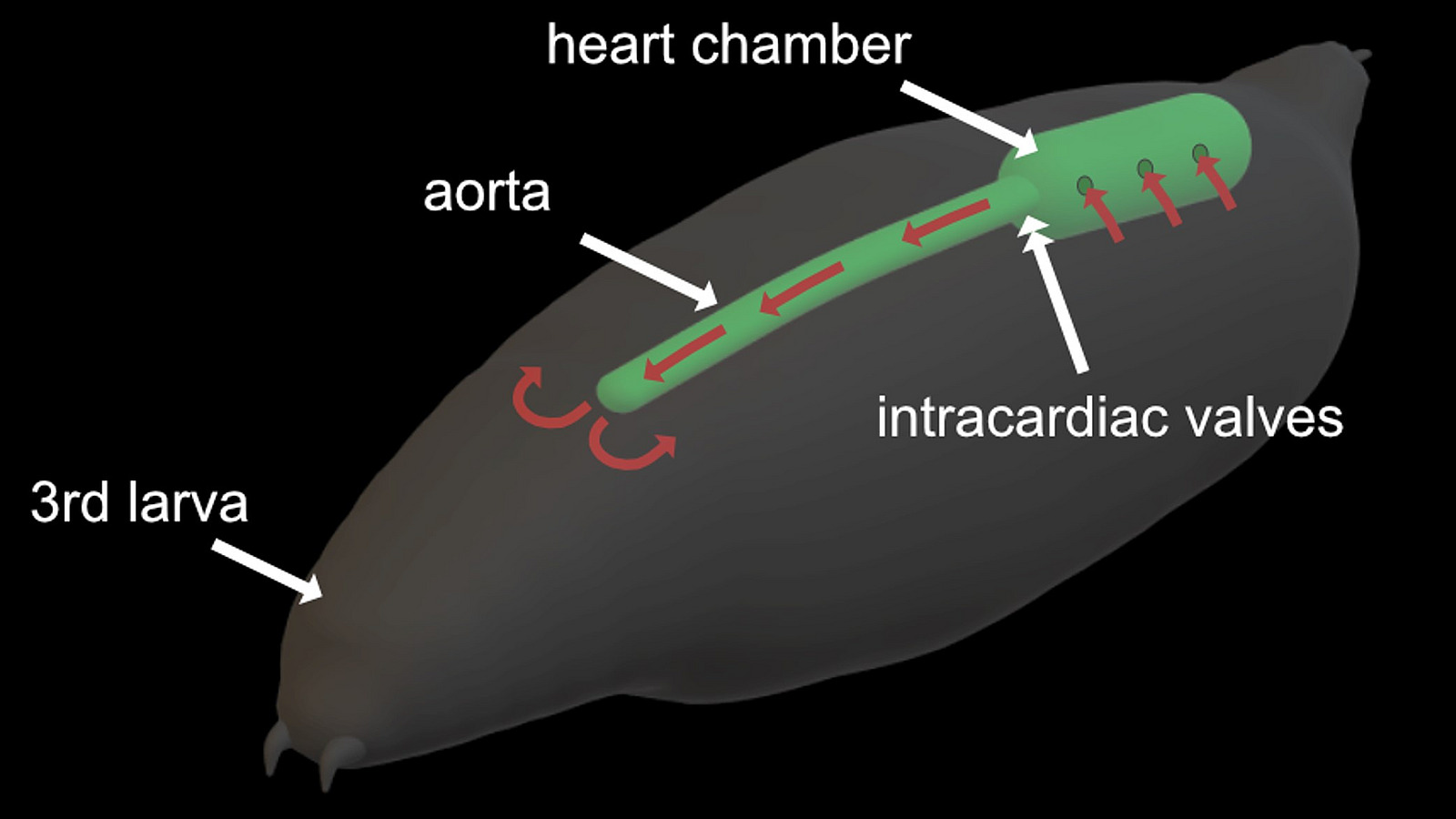
However, the fly's body also has a beating heart that ensures the circulation of the hemolymph and the substances it contains. This consists of a chamber at the rear end of the body and an adjoining aorta that extends into the front end of the body. When the chamber expands, hemolymph from the abdominal cavity enters it through special cellular openings. When the ventricle contracts again, the hemolymph is pumped through the aorta until it emerges into the abdominal cavity at the end of the aorta. This process can be observed particularly well in the light-colored larvae of Drosophila melanogaster: If a dark dye is injected into their posterior body end, it can be followed how it is gradually transported to the anterior part of the body by the contractions of the heart.
A heart valve made of two cells
This method was also used by Achim Paululat and Christian Meyer in their recently published study, in which they examined a special structure in the heart of the fly larvae: the heart valve located between the ventricle and the aorta, which consists of only two cells in the animals and about whose function little was previously known. The researchers examined both Drosophila larvae with normally developed hearts and those whose valve cells were more or less atypically developed due to a genetic modification.
The valve cells influence cardiac performance
The team's experiments revealed that the heart valves have a strong effect on the flow properties of the fly heart. The results suggest that the special cells function as follows: during diastole, they close the heart chamber towards the aorta, thus facilitating the absorption of haemolymph from the abdominal cavity. During systole, on the other hand, they deform and open the exit of the ventricle so that the absorbed hemolymph can flow into the aorta. And as with us humans, there are apparently also health consequences for fruit flies if the function of the heart valves is impaired. The researchers found that the pumping capacity of the heart of larvae with defective valve cells was measurably reduced. In addition, these animals moved less than their conspecifics with normally developed heart valves - and covered significantly shorter distances overall.
Newly developed methods in use
“Our experiments enabled us to show for the first time that the efficiency of cardiac performance in the insect heart is influenced by the intracardiac valves,” explains Achim Paululat. “Some of the methods we used were newly developed and used for the first time to study an insect heart.”
In future experiments, the researchers want to decipher the molecular mechanisms that regulate the formation of heart valve cells. They thus hope to gain new insights into the evolution and function of insect hearts.
Publication:
Meyer C. & Paululat A. (2025): Valve cells are crucial for efficient cardiac performance in Drosophila. PLOS Genetics.