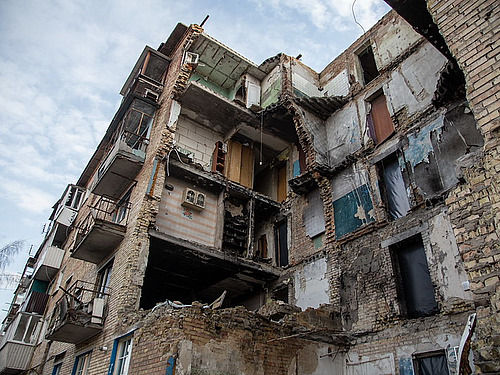
Russia’s war of aggression against Ukraine has upended many assumptions about security and international relations and still poses pressing questions for peace and conflict studies four years after the full-scale invasion began. In the new episode of the Center for East European and International Studies (ZOiS) podcast “Roundtable Eastern Europe” (in German), Prof. Ulrich Schneckener discusses with Prof. Nicole Deitelhoff (PRIF – Peace Research Institute Frankfurt) and Prof. Gwendolyn Sasse (ZOiS) the role of peace and conflict studies and how this discipline can contribute to understanding past and present conflict dynamics.
The podcast episode retrospectively analyzes the escalation of the Russian regime, discusses the shortcomings and adjustments of German as well as international peace and conflict research, and broadens the perspective to include current scenarios: “I also fear that the war against Iran will be another factor making things easier for Russia, as its revenues are likely to rise if the transport of oil and natural gas in the Persian Gulf becomes more difficult. That is likely to make Russian oil and gas more attractive,“ Deitelhoff states, referring to the current war in the WANA region led by Israel and the United States against the Iranian regime. Schneckener also warns that, in the event of a Russian attack, the field of peace and conflict studies faces a particular form of interstate war, ”because it is a war of aggression, conquest, and Russification." This war's nature makes it so “monstrous, because we have not experienced this type of war in Europe since 1939”. Many concepts of conflict management, such as prevention, peacebuilding, mediation, or even liberal peace, cannot be readily applied to this particular type of war, as they primarily stem from the context of intra-state violent conflicts.
Furthermore, the panelists draw attention to the postcolonial experiences of Eastern European countries in the face of Russia's neo-imperialism, which have been neglected for years in both political-media and academic discourses. This “structural amnesia” in research discourses, according to Deitelhoff, must be overcome in order to adequately reflect the technological, ideological, and political changes in the nature of conflict in the 21st century. With regard to East European studies, Sasse also advocates for the development of new interdisciplinary categories to better understand wars and their various manifestations, dynamics, and associated scenarios. These, she notes, are the central questions facing both Eastern European studies and the social sciences in the context of modern conflict research, “which will continue to occupy us for a long time to come.” Deitelhoff refers here to her research group World Orders in Conflict, which brings together economic, historical, and political science perspectives on crises and conflicts with partners in the field.
In response to Sasse’s question about “sources of optimism,” Deitelhoff insists that the impending shift in the international order can be managed less violently, for example through the stabilizing effects of an alliance of many smaller middle powers such as the European Union. Schneckener sees the major challenge, especially in light of Trump’s strategy of dividing political alliances, in determining what necessary collective security should look like and how it can be organized beyond the EU—under deteriorating conditions. This has particularly strong implications for EU policy regarding accession prospects and security guarantees in Eastern Europe.
Click here for the full podcast episode!
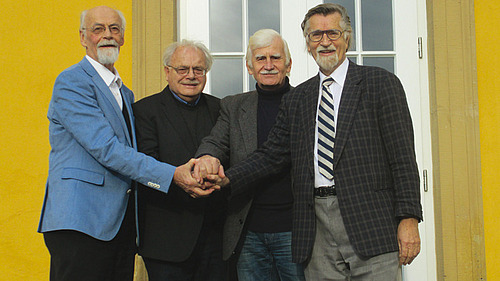
Podcast participants:
Nicole Deitelhoff: Professor of International Relations and Theories of Global Order at Goethe University Frankfurt and Executive Director of PRIF – Leibniz Institute for Peace and Conflict Research in Frankfurt
Ulrich Schneckener: Professor of International Relations and Peace and Conflict Studies at the Center for the Study of Conflict and Peace at the University of Osnabrück and, since March 2016, Chairman of the Board of the German Foundation for Peace Research
Moderated by Gwendolyn Sasse: Research Director of ZOiS and Einstein Professor of Comparative Democracy and Authoritarianism Studies at Humboldt University in Berlin