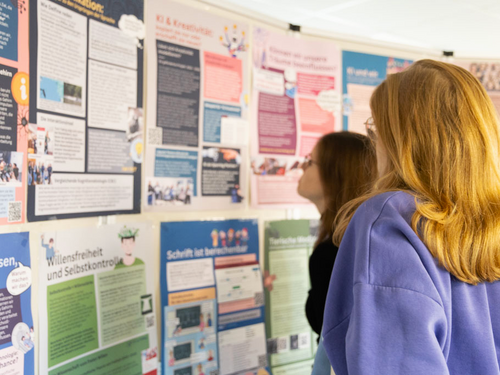
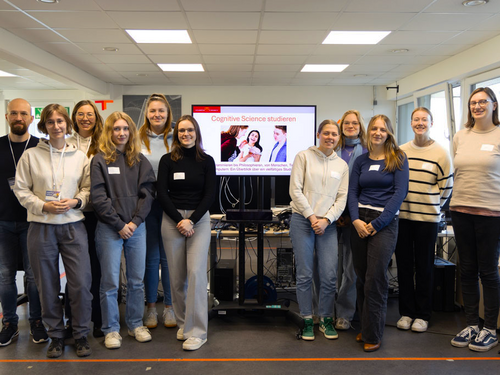
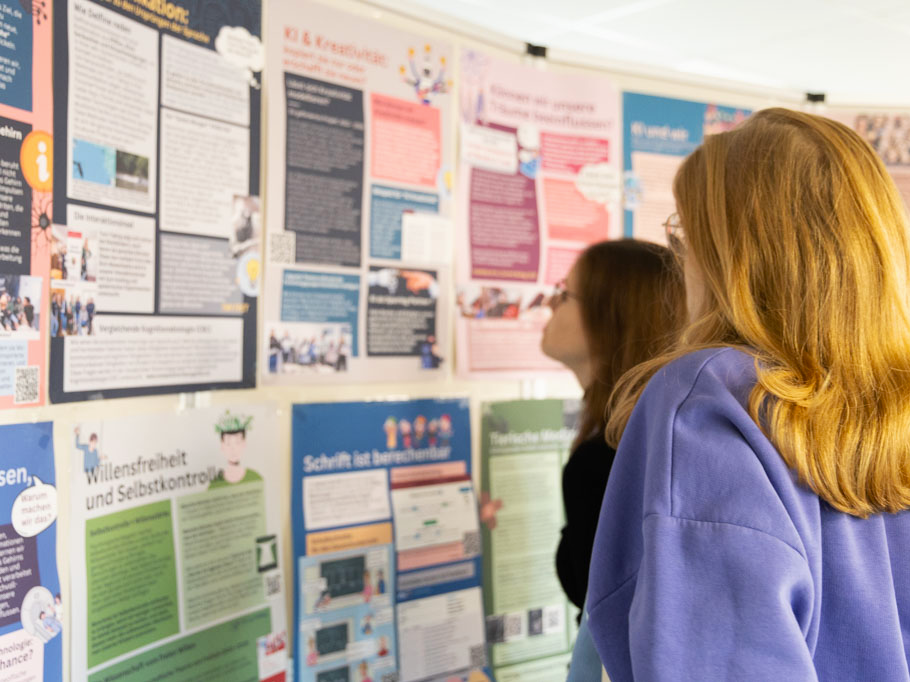
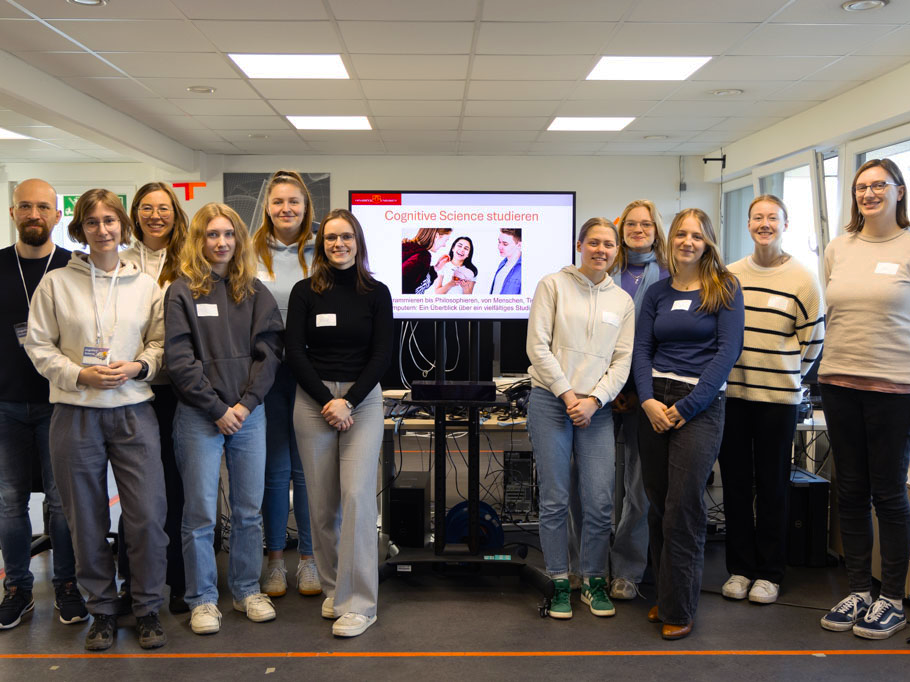
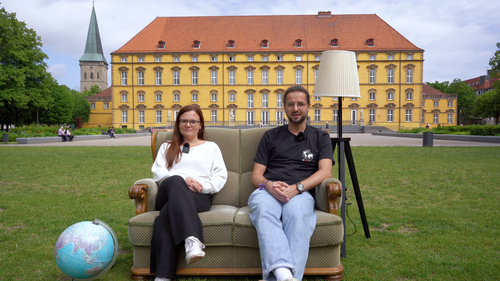
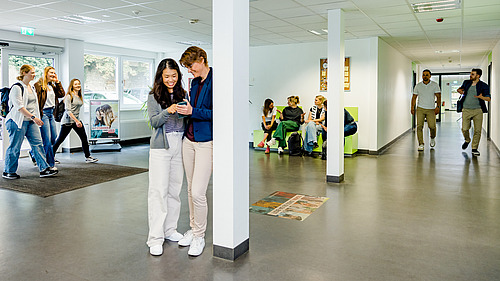
The Niedersachsen-Technikum offers female (technical) high school graduates an insight into various STEM degree courses as part of an internship. In addition to the internship, the Niedersachsen-Technikum also includes laboratory visits, company tours and taster studies. The project aims to encourage participants to pursue a career in STEM subjects. During their visit on 1 December, experiments and exchanges with students gave the technicians an insight into the Cognitive Science course at Osnabrück University.
The supporting program also allows the technicians to explore abstract topics. "Cognitive Science is a unique STEM subject because it combines elements from the natural sciences and humanities," says Gabriela Pipa from the Institute of Cognitive Science. "An additional feature is its international orientation: even the Bachelor's degree is in English and a compulsory semester abroad is part of the curriculum."
There was plenty of inspiration this morning: after short presentations about the subject and student life in Cognitive Science, the coffee break was not only used to make contacts, but also to experiment. At the station with VR glasses (virtual reality), the technicians were able to try out and experience research into cognitive processes such as perception and attention in virtual cities.
In a short lecture, Prof. Dr. Lilian Weber, Professor of Cognitive Modeling at Osnabrück University, spoke about how cognitive models can form a bridge between psychology and neuroscience in order to mathematically predict perception and behavior. Finally, course coordinator Laura Krieger presented the content and process of the English Bachelor's degree in Cognitive Science. What is special about the course is that, at over 50 percent, the proportion of women on this STEM degree course is particularly high and the wide range of modules allows students to learn and combine skills from different sciences - and thus be better prepared for the demands of a dynamic working world.
Above all, this wide selection of elective modules and the combination of different schools, from psychology to philosophy, is unique, said one participant in the final round. Could the engineering students imagine doing taster studies in the summer? Perhaps, but first they would have to process their impressions. "We hope that the visit has shown the technicians new perspectives and inspired them to use these skills in their professional careers," concludes Gabriela Pipa.
The Cognitive Science Bachelor's and Master's taster studies will take place on June 15-18, 2026. The taster week is aimed primarily at high school graduates, students from other disciplines and Bachelor's students from related disciplines.
As part of the six-month Niedersachsen Technikum, (technical) high school graduates complete a paid internship at a regional company four days a week. They also take part in taster studies one day a week, receive company and laboratory tours and gain insights into degree courses. The project focuses on promoting the skills of young women in the STEM sector. The participants receive a certificate of internship from the company and a certificate from the university or college.
Information on the Niedersachsen-Technikum can be found here.
Information on the Bachelor's degree program in Cognitive Science can be found here.
Further information for the media:
Gabriela Pipa, Institute of Cognitive Science
Coordination and Public Relations
E-mail: gapipa@uni-osnabrueck.de