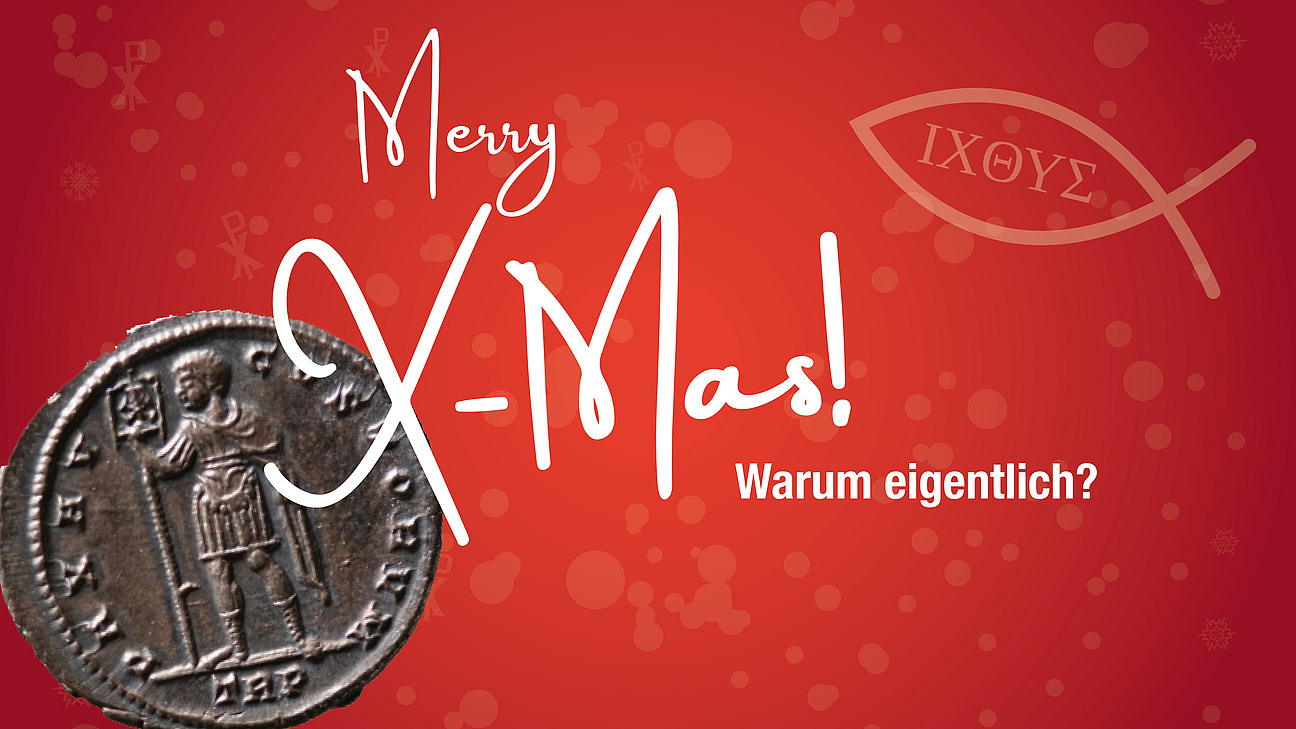
It's very Christmassy again in Germany. When we walk through the streets in December, we inevitably come across stars, nativity scenes, Christmas trees and, of course, lots of advertising. The word "X-Mas" has also become increasingly common. Contrary to what you might think, this is not simply a "cooler" version of "Christmas", but the X follows an almost two-thousand-year-old tradition.
At the beginning of the 1st and 2nd centuries AD, Christianity in the Roman Empire was still a small movement that was often viewed with suspicion. Christians met in house churches and at times suffered local or empire-wide persecution. They were regarded as socially "strange" by the old Roman believers - not least because they refused to sacrifice to the traditional state cults, e.g. the imperial cult. Early Christianity therefore moved between tolerance, ignorance and selective pressure - but it was by no means a recognized religion throughout the empire.
This situation also explains the early communities' choice of symbols. Instead of eye-catching representations, such as the crosses we know today, discreet symbols were used: the fish (Greek: ἰχθύς - Ichthys), whose letters also formed a short profession of faith(Iēsous Christos Theou[H]uios Sōtēr- Jesus Christ, Son of God, Savior), or the so-called Christogram, formed from the Greek letters Χ (Chi) and Ρ (Rho), the initial letters of Χριστός- Christos. These symbols were identity-forming but unobtrusive - a subtle code in a world in which the movement did not yet have official status.
This changed fundamentally with Constantine the Great. As the first Roman emperor to openly embrace Christianity, he adopted Chi-Rho and used it as a symbol on his insignia at an unknown date. In 337 AD, this labarum appears on a follis, a copper coin. Whether one takes the famous vision before the Battle of the Milvian Bridge literally ("In this sign you will be victorious") or understands it as a later story of legitimization, Constantine's policy towards Christianity is clear. The Edict of Toleration of 313 A.D. created freedom for the Church and initiated a process in which Christianity was transformed from a marginal phenomenon into a supporting pillar of the empire. At the same time, Constantine began to structure or reinterpret existing festival times. This included the introduction of Sunday rest. Later developments - such as the establishment of a public holiday for the birth of Christ in December - were based on other Roman festivals and fitted into a politically and religiously reorganized annual structure.
And here the circle closes: the early Christian Chi-Rho spread by Constantine still has an impact today. Even though the Rho (P) was dropped over time, the meaning remained the same - the Chi (X) continues to serve as a symbol for Christ. The spelling "X-Mas" is therefore not a modern "cool" abbreviation, but a distant echo of ancient Christian symbolism.
With this in mind, the Department of Ancient History and Archaeology wishes all readers a wonderful pre-Christmas period and a relaxing and reflective holiday season - regardless of how and whether you celebrate this time in accordance with tradition.
Friedrich W. Brüggemann
Picture credits:
Fish: https://de.wikipedia.org/wiki/Fisch_(Christianity)
Coin: RIC VIII Treveri 30 - numismatics.org/ocre/id/ric.8.tri.30