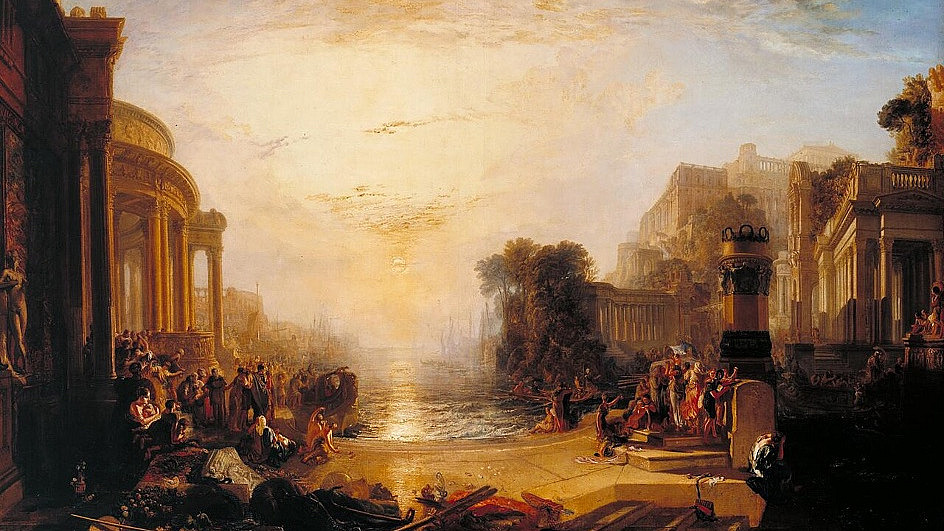
On February 5, 146 BC, one of the most famous conflicts of antiquity ended, marking the beginning of a practice that is still practiced today: the complete annihilation of a defeated party. In this year, one of the largest and most influential cities of its time was systematically destroyed by Roman troops: Carthage in modern-day Tunisia.
The Third Punic War was not a war of equals: Carthage no longer posed a real military threat to Rome. Rather, the city's economic boom was perceived as a threat that was neither considered nor tolerated by Rome. The city had been able to consolidate its position through trade, a focus on intensive plantation farming and internal political reforms made possible by the general Hannibal. There is much to suggest that the upswing was the reason for Rome's radical decision to destroy the city. Not because it was necessary, but because it was militarily possible after the first two Punic Wars.
Memories of defeat, humiliation and existential threats were rare in Rome's history, but in many respects shaped its political self-image. The fact that an existential threat from Carthage no longer existed in 146 BC played a subordinate role in the decision. Security was not seen as a temporary condition, but as a permanent political claim. The Roman politician Cato the Elder played a central role in this debate. As an envoy, he negotiated between rival Carthage and Numidia at the behest of Rome in favour of Numidia, thereby contributing to the destabilization of Carthage. His traditional phrase "Carthago delendum esse" ("Carthage must be destroyed") illustrates this attitude. Carthage was not to be controlled, weakened or integrated into the Roman Empire, but simply razed to the ground. The siege of the city lasted three years. When the Romans finally broke through the walls, fighting broke out within the city. The conquest was completed on February 5, 146 BC. The surviving population was enslaved and the city destroyed. Carthage was removed from the political landscape of the Mediterranean for a long time. The date marks a turning point at which Roman power was increasingly defined by the complete military elimination of the enemy.
Rome's security was not achieved with this policy, because following the cruel annihilation of Carthage and Corinth in the same year, the aristocracy began to tear each other apart.
Niklas Eilers
Picture credits:
Joseph Mallord William Turner: The Decline of the Carthaginian Empire, 1817, oil on canvas, Tate Britain, London. Image via Wikipedia, URL: [Link], retrieved on 05.02.2026.