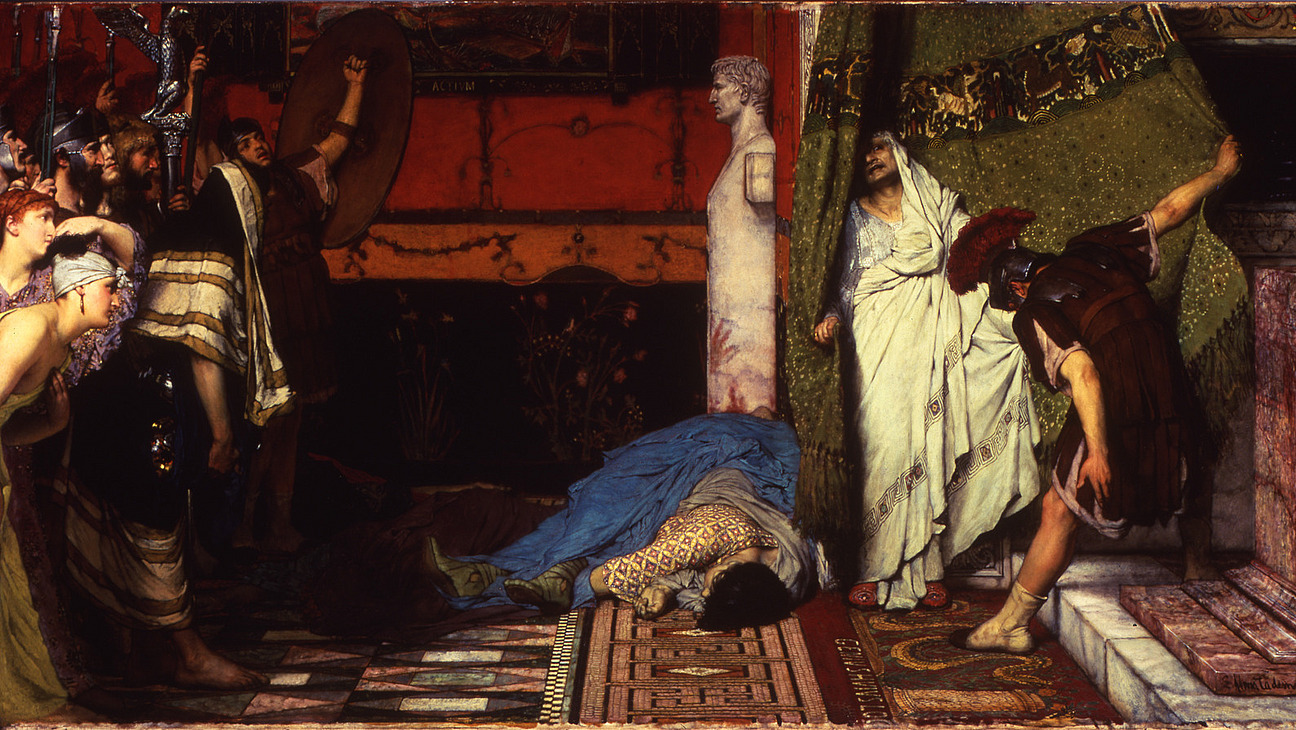
The city of Rome awakens from its slumber and it seems to be a day like any other. The Roman emperor also goes about his daily routine: He enjoys a play and finally makes his way to his chambers for dinner. Little does he know that he will not live to see this meal...
In the 7th hour of the day on January 24, 41 AD, the reigning Roman emperor Gaius Caesar Augustus Germanicus, known today by his nickname Caligula, falls victim to an assassination attempt together with his wife Milonia Caesonia and their daughter Iulia Drusilla. Although the exact sequence of events of the assassination differs between the various ancient historians, they all have one thing in common: Rome was in a state of emergency and the system of rule, the Principate, which had been newly established and then consolidated under his two predecessors Augustus and Tiberius, was probably seriously shaken for the last time. For with the death of the third emperor, the first dynasty, the Julio-Claudian imperial house, was faced with a major problem: Caligula, the last direct male blood relative of Augustus, died - the Principate was left without a successor from the family of the Julii and its future was therefore uncertain.
After the initial immediate unrest, the two acting consuls and the Senate gathered on the Capitol shortly afterwards to discuss the future of the empire: Do they want to return to the old republican regulations? What would happen to the remaining members of the imperial house? Do they want to retain the principate? If so, which of the senators should succeed the hated Caligula? However, this passionate debate remained without result due to the great differences of opinion and the large number of candidates; a final decision was therefore postponed until the following day.
The military, however, had not been idle in the meantime, so they were able to make a decision beforehand. Part of the Praetorian Guard stationed in Rome had searched the imperial palace immediately after the assassination attempt and made a welcome discovery. The guardsmen found Claudius in hiding, Caligula's uncle and the last adult male member of the imperial family (albeit from the Claudian branch of the family). Without further ado, they appointed him emperor (an honorary military title), brought him to their camp on the outskirts of the city, allegedly against his will according to the sources, and proclaimed him the new emperor after promising him a gift of money (15,000 sestertii per man). In addition to the debate in the Senate, the first negotiations with Claudius' party took place on both days. The Senate did not want to agree to the emperor's elevation; Claudius should rather submit to the Senate. However, when the senatorial city cohorts defected to Claudius in the course of 25 January and the Senate found itself without any military support, it had no choice but to recognize Claudius as the new emperor. He was thus the first Roman emperor to come to power by bribing the military and without the Senate. Like his predecessors, the Senate now granted him a comprehensive package of powers (the proconsular imperium and tribunician power should be emphasized here) as well as the names and Augustus.
Regulation was thus restored, the continuity of the Julio-Claudian dynasty was secured for the time being and Rome had a new emperor. He ruled the empire for the next 13 years under the name Tiberius Claudius Caesar Augustus Germanicus.
Patrick Kösters
Sources:
Cassius Dio / Veh, Otto (ed.): Römische Geschichte, vol. 4. books 51 - 60, translation by Otto Veh, Zurich / Munich 1986.
Suetonius / Martinet, Hans (ed.): Die Kaiserviten. De vita Caesarum / Famous men. De viris illustribus. Latin - German, translation by Hans Martinet, Tusculum Collection, Berlin / Bosten 20144.
Literature:
Bernstein, Frank: From Caligula to Claudius. The Senate and the Phantom of Liberty, in: Historische Zeitschrift, vol. 285/1 (2007), pp. 1 - 18.
Eck, Werner: Caligula, in: Cancik, Hubert / Schneider, Helmuth (eds.): Der Neue Pauly, vol. 2, Stuttgart / Weimar 1997, pp. 937 - 939.
Levick, Barbara: Claudius (Roman Imperial Biograhies), London 20152.
Picture credits:
Sir Lawrence Alma-Tadema: "A Roman Emperor: 41 AD" (1871) - The Walters Art Museum, https://art.thewalters.org/object/37.165/