© Osnabrück University / Hermann Pentermann

Research Training Group 2900 "nanomaterials@biomembranes"

The Research Training Group 2900

The mission of “nanomaterials@biomembranes” is to offer interdisciplinary research training at the interface of biology, chemistry and physics. The research program will be focused on developing novel biophysical techniques to resolve dynamic processes at lipid membranes from mesoscopic down to atomic scales. For this purpose, we will exploit the unique electronic and optical properties of emerging nanomaterials to achieve interrogation and manipulation of biological processes with unprecedented spatial and temporal resolution. Projects are organized into highly collaborative, interdisciplinary clusters, each of which is aligned with an overarching aim. Dedicated research training will be complemented by a tailored qualification program to ensure efficient onboarding, successful completion of the PhD project and optimum preparation for further career steps.

© Simone Reukauf
The current PhD students in the graduate school

Events

© Fraunhofer IPM

RTG Speaker Seminar: Prof. Karsten Buse - Fraunhofer-Institut für Physikalische Messtechnik IPM, Freiburg

Title: TBA

© University of Graz

RTG Speaker Seminar: Prof. Dr. Georg Krainer - University of Graz, Austria

Molecular Biophysics for Biohealth and Biotechnology: From Single-Molecule Disease Mechanisms to High-Throughput Microfluidic Discovery

RTG Speaker Seminar: Dr. Agata Witkowska - Leibniz-Forschungsinstitut für Molekulare Pharmakologie, Berlin

Title: TBA

People are sitting in a lecture theatre, looking at a woman sitting amongst them who is speaking into a microphone
© Niklas Kästner

„Engaging, inspiring, motivating“: International Symposium on Biomembranes at Osnabrück University

From 26 to 28 August 2026, the international symposium “Spatial-temporal interrogation of living membranes” was held at the Biology department in Osnabrück. It was organised by Research Training Group 2900 in collaboration with the Summer School of the MemBioMed Master’s program.

A group of young people is standing on a staircase in front of a glass house and smiling at the camera.
© Niklas Kästner

17 students from 14 countries: Osnabrück University welcomes first cohort of students in the international MemBioMed Master's program

They are studying membrane biology at three locations in Europe: After spending time in Nice and Genoa, participants in the MemBioMed program will now spend a semester in Osnabrück. The program kicks off with a summer school featuring an international symposium.

© Gesellschaft für Biochemie und Molekularbiologie e. V.

Price for method development in the RTG2900: GBM-Innovation-Award for Young Scientists

Congratulations to Steffen Harms from the Piehler group on receiving the  GBM Innovation Award for Young Scientists for his contribution: "Reconstitution of Active Signaling Complexes in Live-Cell Nanopatterning". The award was presented at the 28th Meeting on Signal Transduction in Weimar. Steffen's [...]

A microscopic image, with the words ‘Frontiers in Light Microscopy’, ‘Technology Driving Discovery’ and ‘Osnabrück, 11–12 March 2026’ written in front of it
© CellNanOs | Osnabrück University

Experts in advanced light microscopy convene at the CellNanOs

The concluding meeting of the DFG-funded Major Instrumentation Initiative  Innovative Experimental Optical Microscopes for Research was hosted by the iBiOs in the CellNanOs Building. During a lunch-to-lunch symposium, members of the consortium presented their experience with cutting-edge light [...]

© Osnabrück University - Jacob Piehler

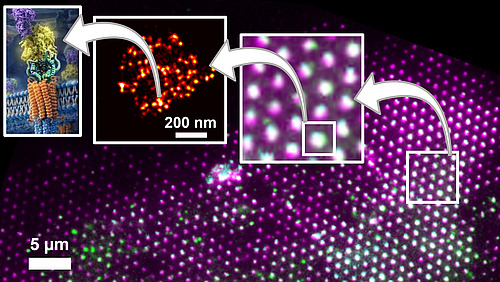
Resolving Immune Signaling Complex Assembly Inside Living Cells with Sub-Nanometer Resolution

How do multiprotein complexes responsible for processing immunological responses assemble inside cells? To address this challenge, researchers from the RTG2900 engineered high-density nanodot arrays using capillary nanostamping and tailored surface chemistry. By capturing transmembrane adaptors, [...]

© Osnabrück University - Daniella Hübner

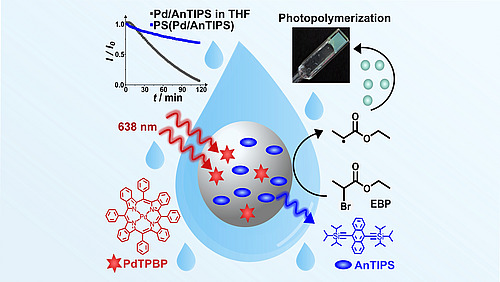
How can red light trigger chemical reactions in water?

Sensitized triplet–triplet annihilation upconversion (sTTA-UC) can convert two low-energy photons into one of higher energy, but its use in water is often limited by the poor solubility of the required chromophores. Researchers from the RTG2900 overcome this challenge by encapsulating a red-to-blue [...]