Conflict Studies and Peacebuilding (M.A.)

We are offering two information events for the winter semester 26/27:
- In-person meeting in Osnabrück: May 12, 2026, 6-7 p.m. (room tba)
- Online meeting: April 14, 2026, 12-1 p.m. CET ( registration by email)
German citizens and international students with German certificates (Abitur, bachelor's degree) or current/completed studies in Germany apply directly via the Osnabrück University online portal. The application period for this is between May 15 and July 15 each year.
International students with foreign certificates and no study experience in Germany apply via uni-assist e.V. The application period for this is between April 1 and June 15 each year. Please see our admission requirements below. Educational background and country of origin can also influence the admission procedure. For further information please contact the Students Office or our Program Coordinator.
What causes violent conflicts? How does political violence shape a society in the long term?
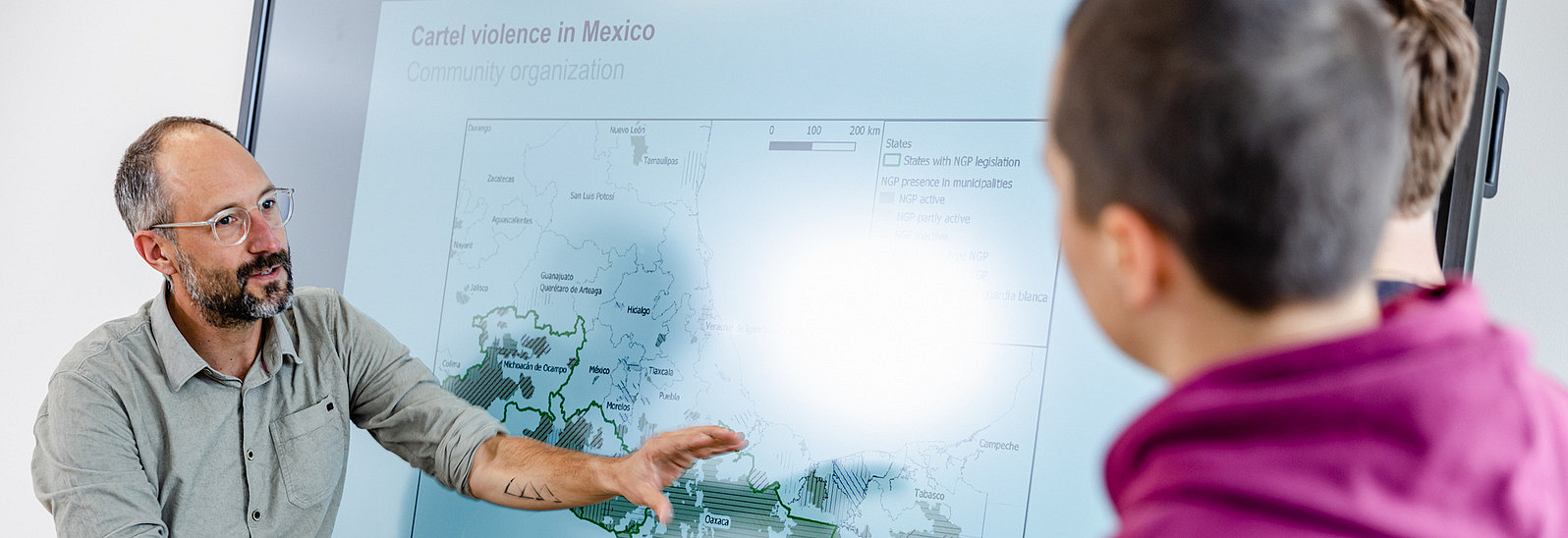
The Master of Arts Conflict Studies and Peacebuilding (CSP) is a four-semester program that provides you with a comprehensive understanding of peace and conflict research within a fragmented world. At the same time, we familiarize you with the practical areas of peacebuilding and conflict transformation. We will introduce you to fundamental concepts, theories and methods of peace, conflict and violence research and combine perspectives from political theory, comparative politics and international relations. You will examine the actors, causes and dynamics of conflicts and political violence as well as the practices of conflict mediation and international peacebuilding. The program combines qualitative and quantitative methods to analyze specific historical and contemporary conflicts and peace processes.
The curriculum is characterized by strong practical components. We integrate practical experience and expertise in the fields of conflict analysis, conflict transformation and peacebuilding. The aim is to apply academic insights and methodological tools to practical challenges and approaches in peacebuilding. We regularly invite practitioners who present their organizations and national as well as international fields of work in a regular series of lectures. Our practical seminars also offer insights into practice-oriented instruments such as project management, methods of program evaluation or academic policy advice.
What role do civil society actors play in the course of peace negotiations and reconciliation today?
At a glance
Course content:
- Analysis of dynamics and causes of violent conflicts
- Insights into peacebuilding and conflict management
- Research-based teaching, excursions & professionalization
- Obligatroy internship in science, politics, NGOs and other subject-related areas
- Possibility of a semester abroad via Erasmus+ or outside Europe
- English-language degree, making it internationally applicable
Degree, duration & admission:
- Master of Arts, 120 ECTS; standard period of study 4 semesters
- Start: Winter semester
- Admission restriction (NC) / Past restrictions
Admission requirements:
- Bachelor's degree in political/social sciences or a related Bachelor's degree (including history, geography, ethnology, social psychology, law, economics) with at least 30 ECTS in political/social science subjects and methods
- Important: Admission may be subject to the condition that a maximum of 16 credit points must be made up within two semesters after starting the master's program!
- English language skills at least B2 according to CEFR
- Please find more information in our regulations on access and admission
Structure of the degree program
| Semester | Module 1 Methods in Conflict Studies and Peacebuilding (10 CP) | Module 2 Concepts in Conflict Studies and Peacebuilding (10 CP) | Module 3 Political Theory and History of Ideas in Conflict Studies (10 CP) | Module 4 Conflict, State & Society (10 CP) | Module 5 Conflict, Politics & the Global Economy (10 CP) | Professional and Research Practice (24 CP) | Electives (22 CP) |
| 1/3 | Research Design in Conflict Studies (6 CP) | Concepts & Theories in Conflict Studies (4/6 CP) | The Modern State in History and Theory (4/6 CP) | Political Institutions and Peacebuilding (4/6 CP) | Conflict Issues in Contemporary Societies (4/6 CP) | Obligatory advisory session in the 1st semester Professional skills Mandatory 2-month internship in the area of Conflict Studies and Peacebuilding Research Seminar Colloquium for Master's Thesis | Elective courses may include:
|
| 2/4 | Practical Approaches to Peacebuilding & Conflict Management (4 CP) | Concepts & Theories in Peacebuilding (4/6 CP) | War and Peace in History and Theory (4/6 CP) | Political Violence and Peacebuilding (4/6 CP) | Conflict and Power in the Global Economy | ||
| 4 | Master's Thesis (24 CP) | ||||||
Application
Admission requirements
A bachelor's degree in social sciences or political science or a comparable degree with a specialization in social sciences or political science is required. Bachelor's degrees in related subjects (history, social geography, ethnology, social psychology, international law, and economics) may also be accepted if you can demonstrate that you have basic knowledge (at least 30 ECTS) in social sciences or political science, including methodology. If you do not have sufficient ECTS credits but submit a strong application overall, the selection committee may grant admission on the condition that you make up for up to 16 ECTS credits in relevant bachelor's courses at the institute during the first two semesters.
In addition, you must demonstrate English language skills at level B2 of the Common European Framework of Reference (CEFR). If English is not your native language, you can prove your B2 level by providing evidence of eight years of successfully completed school English, evidence of a successfully completed language course at B2 level, or successful completion of IELTS (with a minimum score of 5.0) or a comparable language test.
The selection committee reviews all applications and sorts them according to the Cumulative Grade Point Average (CGPA). This consists primarily of the adjusted final grade of the bachelor's degree. However, applicants can improve their CGPA to a limited extent by providing the following evidence:
- an impressive letter of motivation
- several months of practical experience in relevant professional fields of our master's program
- experience abroad
- a very good bachelor's thesis in a specific subject area of our master's program
Required documents for your application
You must include the following documents with your application – copies of certificates and transcripts must be certified (electronically or by stamp):
- final transcript of your bachelor's degree, including a final overview of your grades or, if not yet available, an official certificate of completed courses, credits earned, and adjusted grade point average (transcript of records), as well as a certificate of registration/upcoming assessment of your bachelor's thesis
- curriculum vitae (CV)
- proof of English language skills at level B2 of the Common European Framework of Reference for Languages (CEFR)
- relevant certificates for internships, professional activities, or other important achievements
- optional: letter of motivation, practical certificates, proof of stays abroad, suitable bachelor's thesis (simple description/reading sample is sufficient)
Applicants with German citizenship and international applicants with German qualifications (Abitur, bachelor's degree) or currently studying in Germany apply directly via the Osnabrück University application portal (HISinOne). The application period for this is between May 15 and July 15 each year. Further information is available from our Admissions Office.
As the Master's degree program CSP is admission-restricted (Cumulative Grade Point Average), we ask you to be careful when completing your application. This is the only way we can consider all your qualifications in the selection process.
International students with foreign certificates apply via uni-assist e.V. The application period for this is between April 1 and June 15 each year. Please note that you need to meet certain requirements illustrated above (language skills, bachelor eligibility, etc). Furthermore, the educational background of your country of origin may have an impact on your application. Further information is available at the Admissions Office.
As admission to the CSP master's program is restricted (cumulative grade point average), we ask that you complete your application carefully and in full. This is the only way we can take all your qualifications into account in the selection process.
Activities
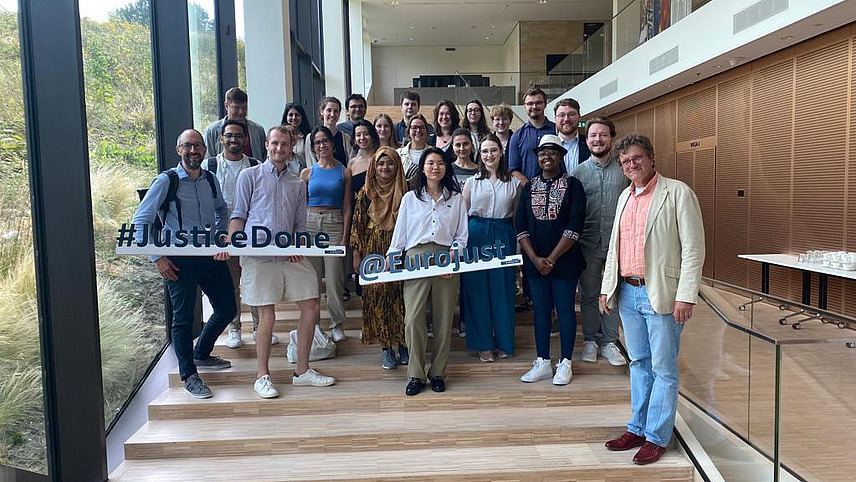
Exciting study trips, active support for semesters abroad, a wide range of electives and an international focus in terms of language, student composition and lecturers round off this Master's program.
Nassim, cohort 2022/2023



FAQs
Your profile:
- Strong interest in current conflicts and peace processes and the relevant actors
- Interest in the challenges facing peace and conflict research in the face of escalating violence and systemic crises
- Ability to work in research, politics, NGOs, and other organizations as part of an internship
- Interest in practical learning: internship, learning practical skills for everyday work, practical guidance for carrying out your own research projects
- Motivation to set your own focus, e.g., on migration, security policy, political economy, advanced methods or language courses.
- Successful completion of an undergraduate degree in social/political sciences or related disciplines (at least 30 ECTS in relevant subjects) & English skills (at least B2)
We train you for careers in the following areas, among others:
- Career opportunities in international organizations and non-governmental organizations at home and abroad
- Qualified preparation for a career in national or international project work in conflict as well as post-conflict regions
- Good entry opportunities in academia and academic research
- Science management, science communication, and journalism
- Our alumni work at universities, research institutes, international NGOs, refugee aid organizations, and in the public service of various countries
We offer you the following benefits:
- Easy access to lecturers at the Institute of Social Sciences
- Extensive elective options in the degree program, opportunities for interdisciplinary specialization in the free elective area
- Support services for career guidance and internship planning
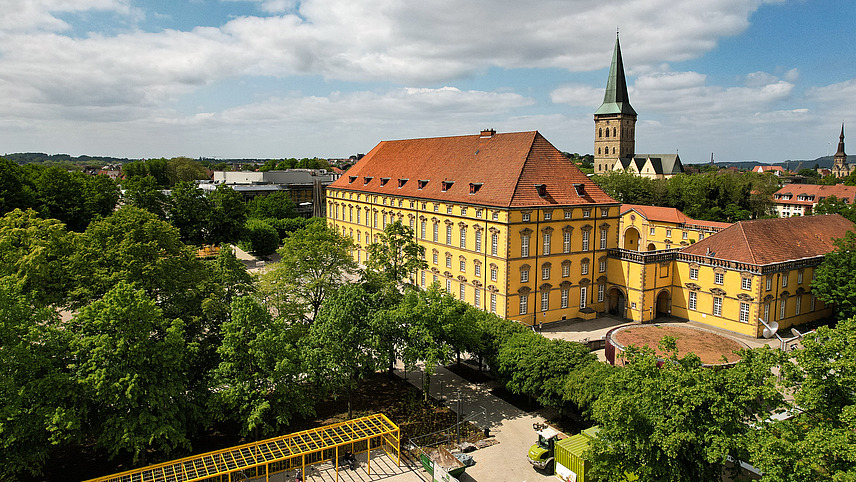
- Modern infrastructure of the institute and the DigiLab in the completely renovated institute building on the university's inner city campus
- Diverse engagement opportunities and support structures at the university, the city of Osnabrück University and within the international Euregio innovation region
- Not yet convinced? Here are 10 reasons for Osnabrück!
Program team
Program directors
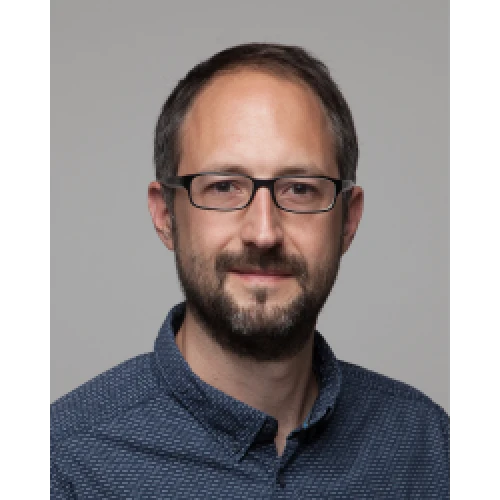
Prof. Dr. Alexander De Juan
Sozialwissenschaften
Seminarstraße 20
49074 Osnabrück
Raum: 15/423b
Sprechstunde: siehe Sprechzeiten auf der Profilseite
