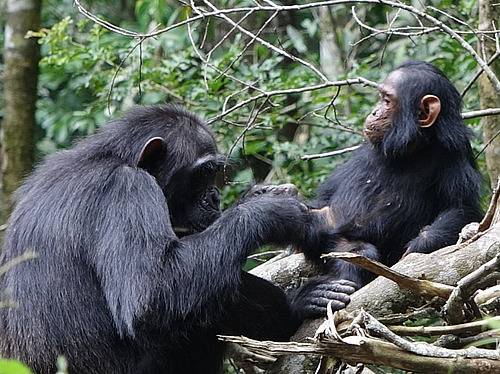
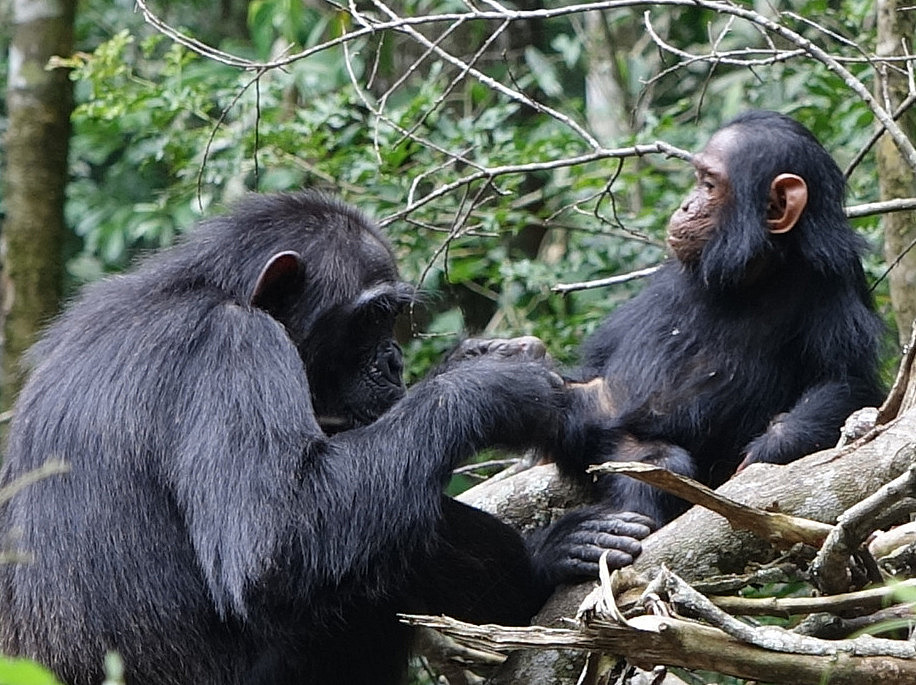
In the wild, chimpanzee mothers and their young take turns during their interactions in ways that are reminiscent of human conversations. This is shown by a recent study by Dr Bas van Boekholt and Prof. Dr Simone Pika from the University of Osnabrück, Germany, in collaboration with Dr. Alexandra Bosshard from the University of Zurich, Switzerland, which has now been published in the journal Proceedings of the Royal Society B. The results suggest that the basic principles of human conversation are much older than previously thought.
By closely analysing interactions between chimpanzee mothers and their young living in their natural environment in the Kibale National Park in Uganda, the scientists were able to show that chimpanzee interactions follow predictable, alternating patterns that are strikingly similar to human conversations in some respects.
‘After observing these mothers and infants in the rainforest for months, I was amazed at how familiar their interactions seemed to me. Even as an outsider to their world, their exchanges were understandable to me because of their predictable structures,’ said Dr. Bas van Boekholt from the Osnabrück University.
Human interactions are based on sequences, the scientist explains: a question requires an answer, a greeting expects a response. These so-called ‘adjacency pairs’ help to organise conversations without determining what the answer will be. An invitation to a party can be answered with “yes”, ‘no’ or even a shrug. This flexible yet highly structured system characterises both spoken and sign languages and begins very early in human development through non-verbal exchanges with gestures and shared actions.
Scientists have long assumed that this organisational structure existed before the emergence of language and may even have been the mechanism that made language possible in the first place. However, earlier studies on animal communication focused primarily on signal sequences produced from the same individuals and less on dynamic reciprocal interaction between animals.
For their study, researchers from Osnabrück and Zurich observed 17 chimpanzee mothers and their young from the Ngogo community and filmed their interactions. They analysed how predictably individual actions and signals followed each other and how flexibly the animals responded to each other. The results showed that many of the alternating signals follow fixed patterns that resemble early forms of human question-answer structures. A network analysis also revealed that certain actions and gestures occur together particularly frequently – similar to ‘topics of conversation’ in human dialogues.
‘For decades, studies suggested that chimpanzee’s interactions bore little resemblance to human language, but now we know that the underlying structure is very similar and systematically organised – a finding that encourages further research,’ says Prof. Dr. Simone Pika from the Osnabrück University. According to the behavioural biologist, the study opens up new possibilities for further comparisons within the animal kingdom that could shed light on when these interactive building blocks of human language first emerged.
Further information for the media:
Prof. Dr. Simone Pika, Osnabrück University
Institute of Cognitive Science
E-mail: spika@uos.de