Team
Work culture
We are a young and diverse team working on a broad range of topics. An inclusive working atmosphere, gender equality, and consideration of the needs of young scholars with children are particularly important to us. We sincerely welcome requests for collaborations and invite interested people to reach out and join us , for instance, in our colloquium

Members

Rainer Mühlhoff's research on artificial intelligence views machine learning systems as socio-technical systems (see Human-Aided AI). In order to develop the ethical and social implications of AI technology, he examines the interplay between technology, power and subjectivity, drawing on various sub-disciplines and philosophical schools. In particular, he integrates ethics with contributions from social philosophy and critical theories in order to analyze the effects of AI in terms of discrimination, social selection and inequality (see Automated Inequality).
A particular research interest is data protection and data ethics in the context of AI and big data. These technologies make it possible in a new way to predict sensitive information about individuals based on the anonymized data of many other people. This results in a new type of collective violation of the privacy of those affected. Under the term predictive privacy, Rainer Mühlhoff develops an ethical and regulatory approach that responds to the potential for misuse of predictive analytics.
Nora is a research assistant and PhD student in the Ethics and Critical Theories of AI research group at the Institute of Cognitive Science at the University of Osnabrück. Working with critical theories of the digital, feminist science and technology studies, and post-anthropocentric theory, her research focuses on the individual and collective implications of social chatbots and language technologies. In her dissertation, she develops a post-anthropocentric, power-aware ethics of chatbots. Trained in Cognitive Science and Liberal Arts and Sciences, she has a highly interdisciplinary background in critical theories, gender and critical race studies, science and technology studies, as well as neuro and data ethics.
Nora Freya Lindemann

Room: 50/317
Phone: +49 541 969-2489
Paul Schütze

Room: 50/317
Phone: +49 541 969-2489
Paul is a research assistant and doctoral student in the Ethics and Critical Theories of AI research group. In his current research and teaching he is interested in the societal impacts and ethical challenges of digital technologies as well as in social philosophy of the climate crisis. Particularly, in his PhD thesis he is interested in how AI technologies are structurally connected to the climate crisis. His work focuses on critical social philosophy, ethics of artificial intelligence, philosophy of the climate crisis, philosophy of technology and media studies.
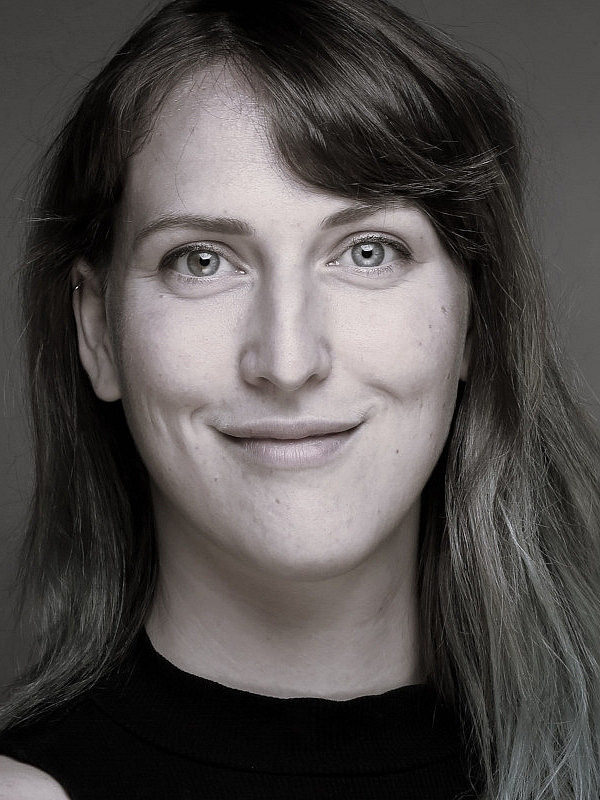
Annemarie has been a member of the research group since 2021. With an interdisciplinary background in Cognitive Science, her expertise encompasses both AI and critical philosophy. Her interests include various power differentials in the digital realm, ranging from the impact of AI technologies in pornography, to exploring how AI discourse impacts emancipatory collective futures thinking. She currently works in our MWK-funded project “Predicted Futures?”, in which she collaborates with several cultural institutions and local high schools, bridging critical research and public outreach. She is further pursuing an additional Master’s degree in Degrowth at the Universitat Autònoma de Barcelona, as an opportunity to dive deeper into anti-colonial theories and post-capitalist economics.
Annemarie Witschas
Room: 50/320
Jan-Philipp Siebold

Jan-Philipp Siebold is a research assistant in the Ethics and Critical Theories of AI research group at the Institute of Cognitive Science at the University of Osnabrück. After finishing his BA in Liberal Arts and Sciences with a specialisation in Political Philosophy, Social Philosophy as well as Cultural and Media studies, he is currently completing his MA in Philosophy at the Freie Universität Berlin. His research focuses on French Social Philosophy, Critical Theory and Philosophy of Technology with a special interest in power, subjectivity and affectivity in digital media cultures and AI systems.
Anna Kraher is a research assistant in the research group Ethics of AI at the Institute of Cognitive Science at Osnabrück University. In her research and artistic practice, she deals with power relations through technologies, in particular with the relationship between predictive analytics, temporalities and (just) futures. She studied Design & Computation, Computer Science and Gender Studies in Berlin.
Anna Kraher

Sean Quägwer

Sean Quägwer is a research assistant in the Ethics of AI research group at the Institute of Cognitive Science at Osnabrück University. He holds a Master's degree in Philosophy and is currently studying Cognitive Science. He is interested in feminist ontology, science and technology studies and postmodern theories of (digital) societies. Due to his background in philosophy, English and cognitive science, he has a broad background in critical social philosophy. In the context of the aforementioned work, he is currently primarily concerned with digital fascism and the complex of topics AI and school.
Lay is a student assistant in the research group Ethics and Critical Theories of AI at the Institute of Cognitive Science at Osnabrück University, where Lay also completed a bachelor’s degree. Lay’s bachelor’s thesis explored processes of subjectivation within the context of generative AI designed and used for artistic purposes. In the master’s program in Cognitive Science, Lay critically examines ethical and philosophical questions concerning digital media and AI from a feminist perspective.
Lay Vu

Secretariat
Andrea Katz

Room: 50/319
Phone: +49 541 969-2904
Andrea works in the secretariat of the Ethics and Critical Theories of AI research group. She originally trained in the banking sector and has been working as an administrative assistant at Osnabrück University since 2019.