Research data management

Research data management

Research data management (RDM) is far more than just an administrative necessity - it is an integral part of good research practice. Effective RDM is essential for high-quality, reproducible and traceable research. It promotes collaboration, efficient data use and compliance with funding guidelines.

The Biology department supports researchers in all aspects of RDM - from planning to long-term archiving of research data. We offer  RDM software,  services and personal  advice to simplify the structuring, documentation and sharing of research data and to increase its findability and comprehensibility.


Lifecycle of research data

More information on the individual core aspects of RDM can be found under:

 Planning & documentation of data

 Storage & processing of data

 Publication & archiving of data
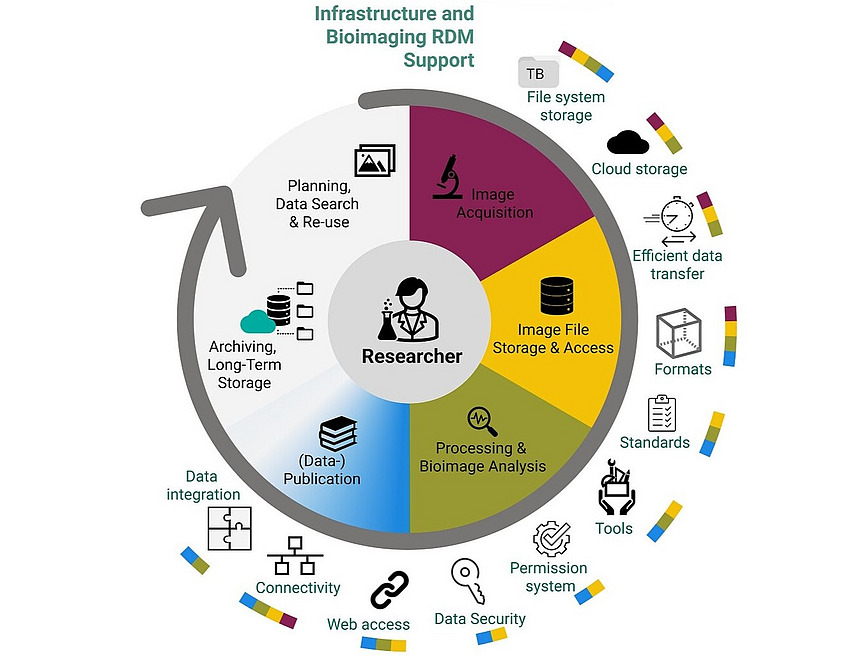


Circular diagram illustrating the lifecycle of research data and the various aspects of infrastructure and data management support provided by central institutions. At the center is the 'Researcher'.  The data lifecycle is shown around the researcher, including 'Image Acquisition', 'Image File Storage & Access', 'Processing & Bioimage Analysis', 'Data (Publication)', 'Archiving, Long-Term Storage' and 'Planning, Data Search & Re-use'. Further outside are the infrastructure/support areas such as 'File system storage', 'Cloud storage', 'Efficient data transfer', 'Formats', 'Standards', 'Tools', 'Permission System', 'Data Security', 'Web access', 'Connectivity' and 'Data Integration'.
© Susanne Kunis | I3D:bio
© Biology UOS

Do you have any questions?

Please contact the  RDM team or simply drop by (38/216)!