Can artificial intelligence make agriculture more productive, more sustainable and possibly more cost-effective in the future? How can a resilient economy be increasingly promoted in the agricultural, food and bioeconomy sectors? These are the questions addressed by the AI Real-World Laboratory Agriculture (RLA).
The Volkswagen Foundation is providing project funding of € 18.9 million for the RLA via the Ministry of Science and Culture as part of the zukunft.niedersachsen initiative. The German Research Center for Artificial Intelligence (DFKI), Osnabrück University (HSOS), the Agrotech Valley Forum e. V. (AVF), the University of Applied Sciences of Osnabrück (HSOS) and the University of Applied Sciences of Osnabrück are participating in the five-year project under the consortium leadership of Osnabrück University.V. (AVF), the Technical University of Braunschweig (TUBS), the Johann Heinrich von Thünen Institute, the Leibniz Institute for Agricultural Engineering and Bioeconomy e.V. (ATB) and the Netzwerk Ackerbau Niedersachsen e.V. (NAN).
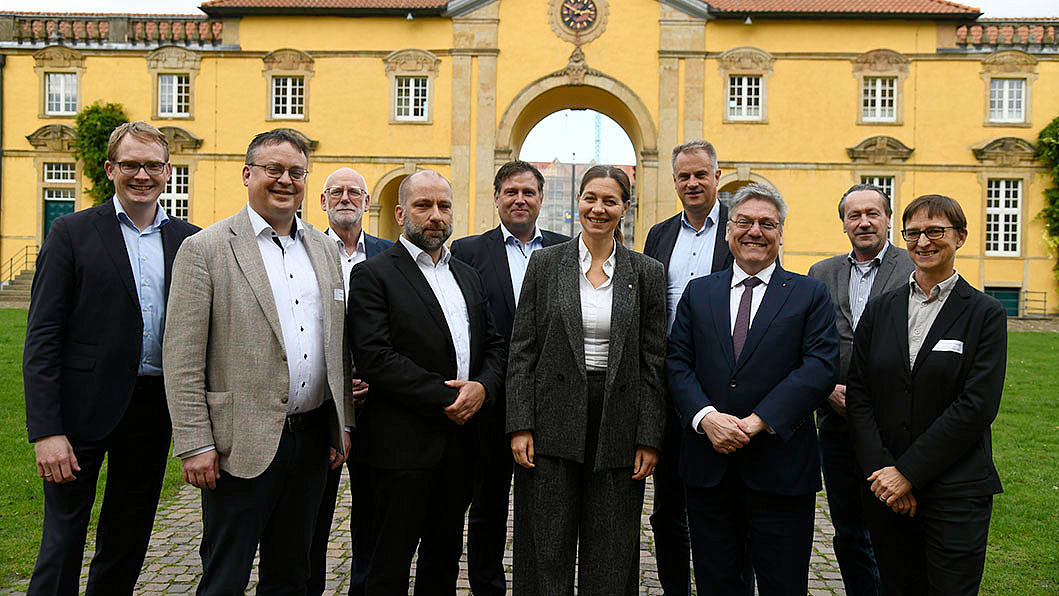
"We are setting new standards with the new AI Real Lab Agriculture," said Prof. Dr. Susanne Menzel-Riedl, President of Osnabrück University at the launch event in Osnabrück Castle. "After all, agriculture is facing a future full of challenges. And I'm not just talking about the highly problematic effects of man-made climate change. The situation is exacerbated by constantly rising production costs and a worrying shortage of skilled workers. There are tasks to be tackled that require different perspectives. And it is precisely for this reason that all the scientists involved in the project contribute such diverse expert knowledge that we can truly speak of interdisciplinarity in action."
Prof. Dr. Joachim Schachtner, State Secretary for Science and Culture in Lower Saxony, added: "The KI Reallabor Agrar and the two joint projects are conducting essential research for Lower Saxony as the number one agricultural state. We hope to gain insights into how the transformation towards a sustainable agricultural and food system can succeed."
In the Osnabrück region, an agricultural technology test farm for testing and validation - the FieldLab Agrar - is to be built and filled with life in the coming year. "As a first step, we want to test semi-automated technology here as a focus of our work, while also keeping an eye on the economic components," explains Prof. Dr. Tim Römer from the Institute of Mathematics at Osnabrück University. Agricultural equipment is expensive - instead of directly purchasing a new tractor, the aim is therefore to examine the possibility of retrofitting existing technology.
It is particularly important to the researchers that the scientifically supported use of AI also has a practical application in agriculture: "We want to enter into an exchange with companies and vocational schools and can also very well imagine demonstrating the use of the latest technologies to vocational and technical school teachers," says Römer. The AI-Reallabor Agrar is intended to be a platform that closely links science, practice and education.
Until then, office space and storage facilities will initially be created and further staff will be recruited, whereby the recruitment process will be interdisciplinary - in addition to computer scientists and mathematicians, people from agricultural or commercial degree courses and technicians will also be sought. Lawyers also play a very important role in the RLA, as the further development of the legal framework for the use of AI and robotics in agriculture is one of the core objectives of the research project.
Further information for editorial offices:
Prof. Dr. Tim Römer, Osnabrück University
Institute of Mathematics
tim.roemer@uos.de