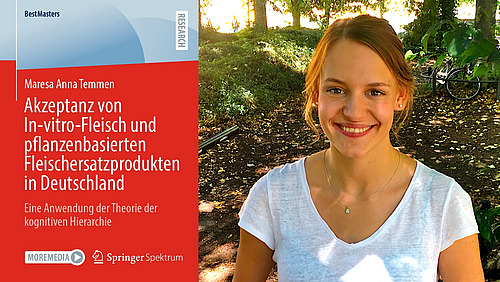
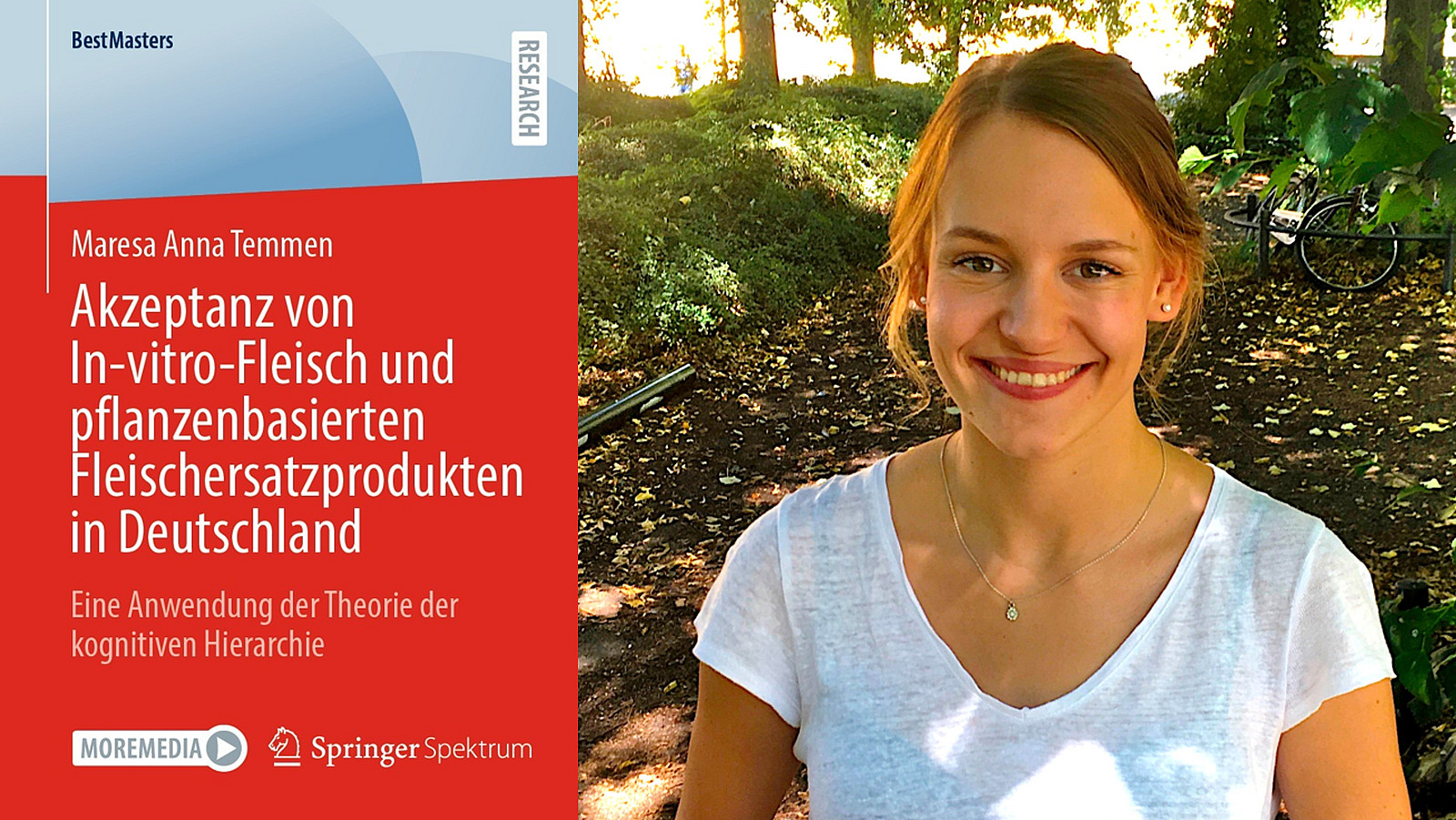
BestMasters Award: Maresa Temmen’s thesis published by Springer

How widely accepted are meat substitutes in Germany? Maresa Temmen addressed this question in her master's thesis in the Biology Didactics division. She received top marks for her work and was awarded the ‘BestMasters Award’ by Springer Verlag.

In recent years, the range of plant-based meat substitutes available in German supermarkets has grown considerably. And the development of meat from cell cultures is also making progress - although related products are not yet approved for consumption in Germany.

Whether these alternatives will prevail over meat from slaughtered animals depends not least on public acceptance. Maresa Temmen used an online survey as part of her master's thesis to investigate the situation. She paid particular attention to the influence and interaction of values, value orientations and attitudes on the willingness to consume selected meat alternatives.

Exciting insights into scientific work

"One of the interesting things for me was to contrast cultured meat and plant-based meat substitutes," Temmen says. "Both products are quite similar on the one hand, but fundamentally different on the other. That was also evident in the survey results."

"I particularly liked the fact that after developing the research questions and hypotheses, I was allowed to plan, implement and evaluate the associated data collection myself”, she continues. “This gave me the chance to go through the entire process of scientific work. In addition, she says, it was very exciting that more than eight hundred people from all over Germany took part in the survey. "This was only possible because of Florian Fiebelkorn and the Biology Didactics group - thank you again!"

About Maresa Temmen: Maresa Temmen studied biology and physics at Osnabrück University and recently completed her traineeship. After the summer vacations, she will start her first job at a grammar school in Mettingen.

About the "BestMasters" series: With a publication in the "BestMasters" series, Springer Verlag says it honors " best master’s theses which have been completed at renowned Universities in Germany, Austria, and Switzerland". The series covers current issues from various fields of research in natural sciences, psychology, technology, and economics.
Related news

Students are sitting in a seminar room; Roland Brandt is standing at the front. Behind him, the words “Welcome at Osnabrück University!” are projected onto the wall.
© Laura Elpers | Osnabrück University

Start of studies in the summer semester of 2026: The Biology department welcomes its new Master‘s students

The Biology department is delighted to welcome 24 new students to the international Master‘s programs “Biology – From Molecules to Cells” and “Nanosciences – Materials, Molecules and Cells” for the summer semester.

Kerstin Bartscherer is standing in front of a blackboard and smiling at the camera
© private

The secret recipe for tissue healing: Prof. Dr. Kerstin Bartscherer on regeneration and cell therapy

How can tissue regrow without scarring? How can stem cell research be put into practice? Prof. Dr. Kerstin Bartscherer talked about this in our university's "UOS asks questions" series.

Three men and a woman are looking at a planter box.
© Alexandra Lohstroh

Climate protection needs diversity: Botanical Garden involved in wild plant conservation project

At the beginning of 2026, a project was launched that focuses on the important contributions of botanical species conservation to natural climate protection. One of the project partners is the Botanical Garden at Osnabrück University.

Johannes Krause is leaning against a wall.
© Thomas Victor

The genetic history of the plague: Leibniz Prize winner Johannes Krause talks about his research

On January 15, 2026, archaeogeneticist and Leibniz Prize winner Prof. Dr. Johannes Krause will be a guest at the Biology department and will give a lecture on his research into the pathogen that causes bubonic plague.