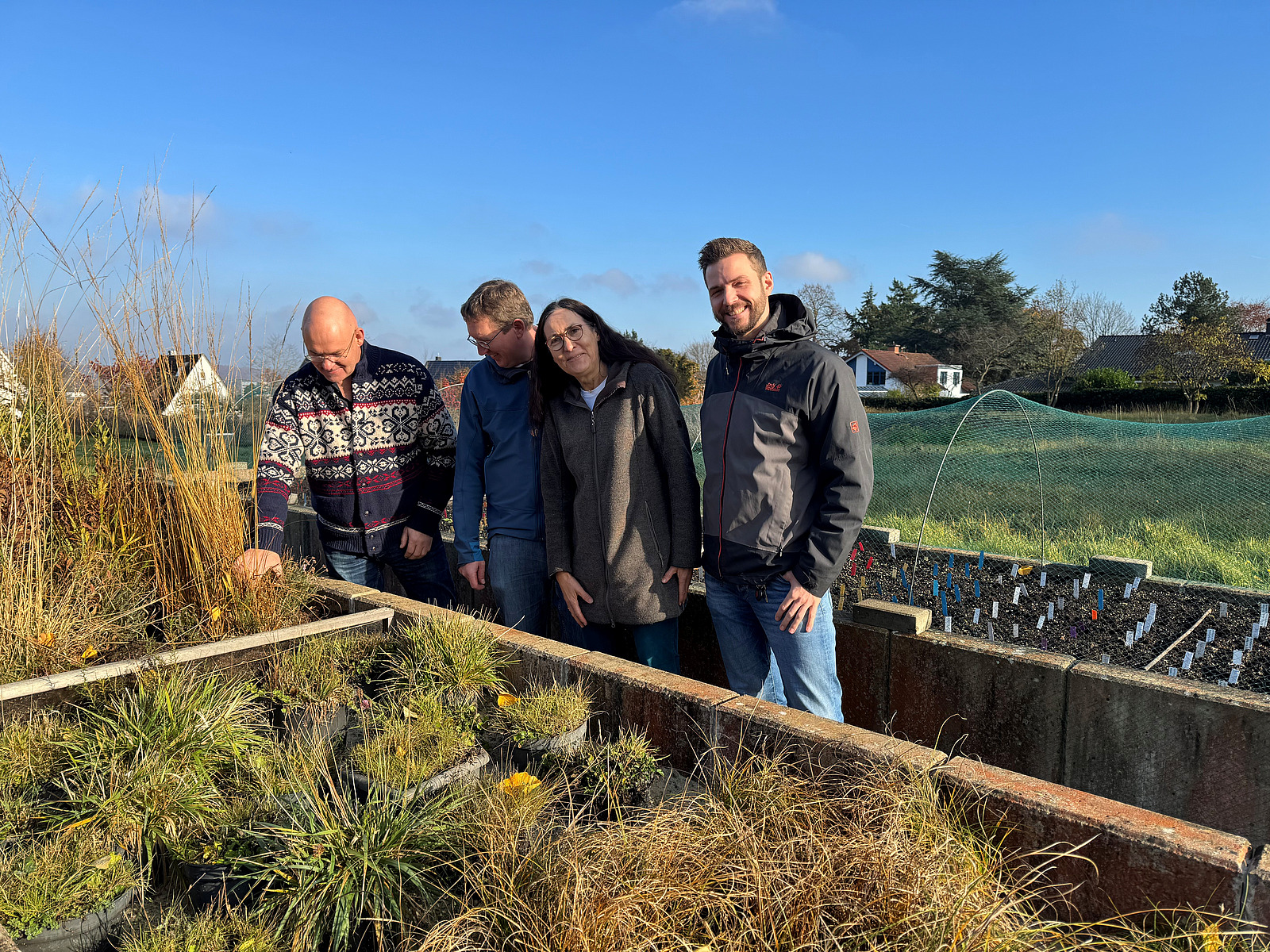
The nationwide joint project in the Natural Climate Protection Action Program is entitled "Saving wild plants: preserving diversity, protecting the climate" (WiVi-Klima). "I am looking forward to working with Dr. Peter Borgmann, Dr. Jens Koczula and PD Dr. Stefan Abrahamczyk in Osnabrück to help safeguard biodiversity and strengthen wild plants as a central basis for natural climate protection and habitat restoration," says Prof. Dr. Sabine Zachgo, Director of the Osnabrück Botanical Garden.
The aim is to secure wild plant diversity as the basis of climate-resilient ecosystems and thus make an effective contribution to natural climate protection in Germany. The President of the Federal Agency for Nature Conservation (BfN), Sabine Riewenherm: "Species-rich and genetically diverse plant populations fulfil key functions for climate protection: they stabilize ecosystems, promote carbon storage, regulate water and nutrient balances and increase adaptability to climate change. The continuing decline of rare and endangered wild plants is increasingly weakening these services provided by nature. This is where WiVi-Klima comes in and specifically strengthens those plant species that are indispensable for functioning natural habitats and their climate functions."
The project combines plant protection measures on site (in situ) with measures outside the natural habitat (ex situ). The central measures include the collection and long-term safeguarding of wild plant seeds, the preservation of genetic diversity in gene banks, the cultivation and propagation of endangered species as well as their targeted reintroduction and population support. These approaches are complemented by success monitoring, modern data infrastructures and training and dialog offerings. The project partners - Osnabrück and four other gardens from Berlin, Mainz, Potsdam and Regenburg - are building on their valuable experience and the infrastructure of the predecessor project "Wild Plant Conservation Germany" (WIPs-De) - funded by the Federal Biodiversity Program in the Federal Nature Conservation Fund with funds from the Federal Ministry for the Environment, Climate Protection, Nature Conservation and Nuclear Safety (BMUKN).
In coordination with the specialist authorities of the federal states and nature conservation stakeholders, the newly launched project is developing a cross-state, needs-oriented concept that provides concrete recommendations for action for botanical species conservation. Over the course of the project, further potential partners and stakeholders will be sought to expand the network. The political goal is the nationwide, long-term successful implementation of the concept by the federal and state governments. As part of the project, best practice examples from various regions will be presented to illustrate how proven instruments can be effectively integrated into existing nature conservation structures.
WiVi-Klima is being funded by the BfN as part of the Natural Climate Protection Action Program with funds from the BMUKN with a total volume of around € 2.9 million spread over three years. WiVi-Klima creates the technical and organizational basis for a permanent nationwide competence network for botanical species conservation, which is to be permanently financed by the federal and state governments from 2029.
Background
Natural Climate Protection Action Program
The Federal Government's Natural Climate Protection Action Program supports measures that combine climate protection with the creation and strengthening of diverse ecosystems. Forests and floodplains, meadows and moors, oceans and water bodies as well as near-natural green spaces in populated areas absorb carbon from the atmosphere and store it in the long term. They also act as a buffer against the consequences of the climate crisis by absorbing heavy rainfall and floods and providing cooling in hot weather. At the same time, they preserve our livelihoods, provide important habitats for animals and plants, store water and are places of refuge for people.
Project WIPs.De: https://www.wildpflanzenschutz.uni-osnabrueck.de/
Natural Climate Protection Action Program: https://www.bfn.de/thema/aktionsprogramm-natuerlicher-klimaschutz
Press release:
https://www.bfn.de/pressemitteilungen/mehr-pflanzenvielfalt-fuer-den-natuerlichen-klimaschutz
Further information for editorial offices:
Prof. Dr. Sabine Zachgo, Osnabrück University
Director of the Botanical Garden
sabine.zachgo@uos.de