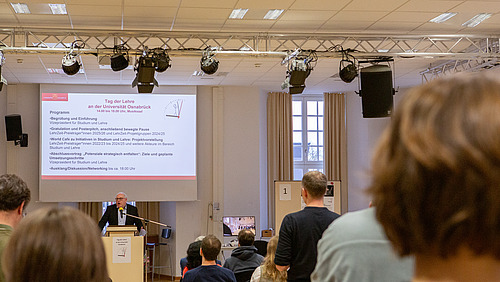
How has political engagement in studies and at universities developed over the decades? And what role do universities play as a place of opinion-forming and social discourse? These questions will be the focus of an event on Thursday, 12 June, which will take place as part of the exhibition "#ChallengingDemocracy - From Helmut Schmidt to Today" as a joint project of the Federal Chancellor Helmut Schmidt Foundation (BKHS), Osnabrück University Library and the Chair of Modern History and Historical Migration Research. The event begins at 7 p.m. in the University Library at Westerberg, Nelson-Mandela-Platz 1.
Participants, moderated by Lisa Querner (BKHS), will be Gloria Sherif, Frederik Göcke, both current students at Osnabrück University, as well as Heike Tennstädt and Heiko Schulze, who began their studies in Osnabrück in the 1970s.
"Politics? I don't have time for that" - a sentence that can be heard again and again at universities. Between the pressure to perform, earning a living, growing up and the supposed "best time of life", there seems to be little room for political engagement for many students. At the same time, political disputes are also shaking up universities in Germany these days, students are getting involved in political processes as citizens and are also making their voices heard in higher education policy contexts between academic self-administration and the dispute over study and working conditions at universities.
"The special thing about this evening," says historian Prof. Dr. Christoph Rass from Osnabrück University, "is that we are bringing together Osnabrück University students from the 1970s with today's students." Since the 1970s, German universities have become increasingly democratized - more co-determination, more participation, but also more responsibility, and Osnabrück University was founded in 1974 in the middle of this process. How did the students at the time experience this change? How do today's students use the democratic spaces available to them at the university? After the intergenerational discussion, the audience is invited to take part: free seats are available at the discussion table in an interactive fishbowl format.
Further information for editorial offices:
Prof. Dr. Christoph Rass, Osnabrück University
History Department
crass@uni-osnabrueck.de