News Detail Page

111/2025
Osnabrück and Princeton

Initiative investigates the possibilities of AI-supported research

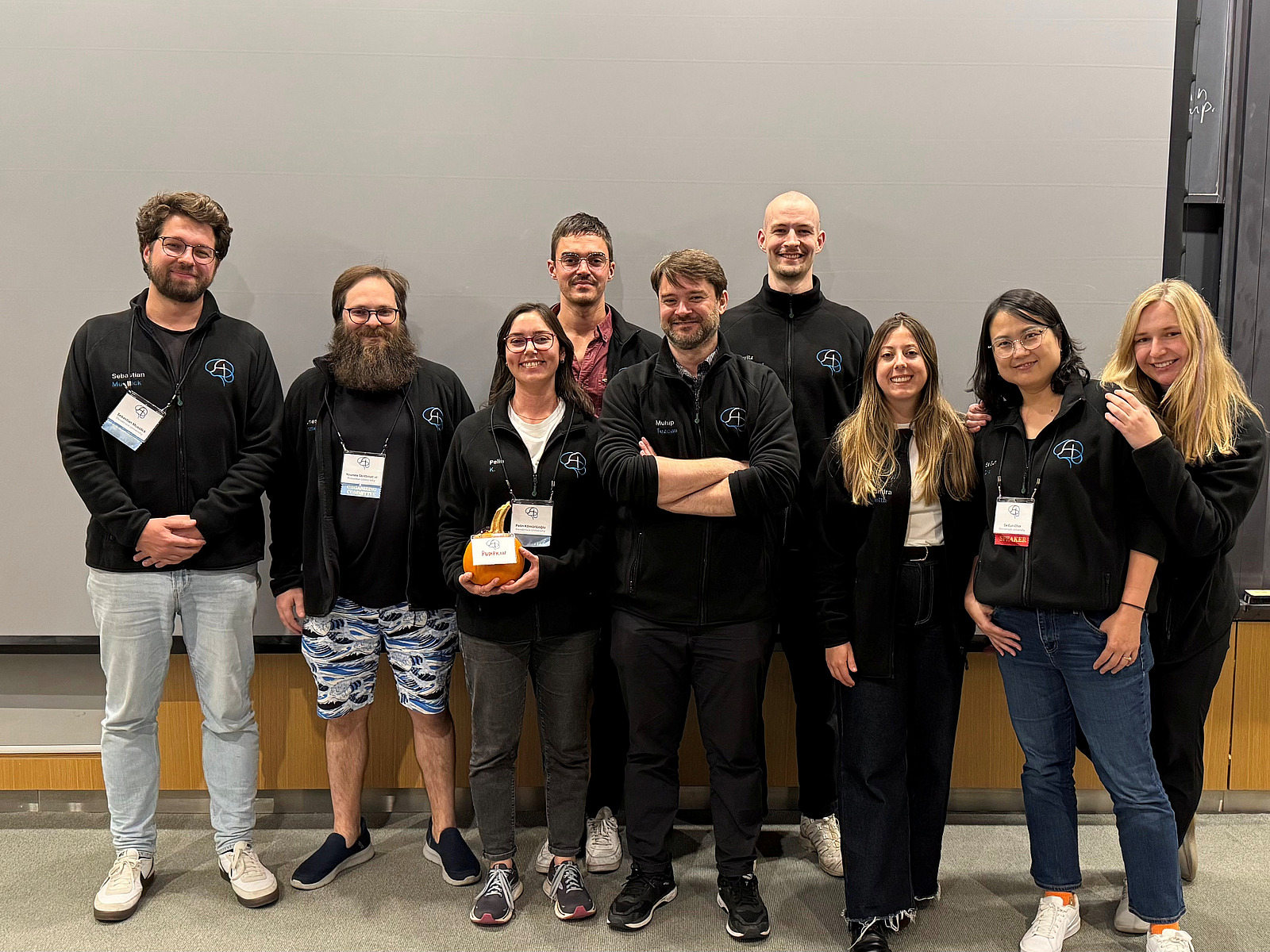
AI and automation are changing the way science is conducted. To explore this development, Prof. Dr. Sebastian Musslick from the Institute of Cognitive Science initiated a workshop with Princeton University.

The theme of the meeting, which took place from September 23 to October 3 at Princeton University, was "Automated Scientific Discovery of Mind and Brain".

The two-week workshop brought together researchers and students from the fields of psychology, neuroscience, cognitive science and artificial intelligence to discuss and experience how new AI technologies can accelerate and automate key aspects of scientific discovery, such as experimental design, data collection and modeling.

"We are witnessing a transformation where AI is not only assisting scientists, but increasingly participating in the discovery process itself," said Prof. Musslick. "Our aim was to examine the impact of this development on the study of mind and brain and to lay the foundations for future collaborations in this exciting new field."

The workshop was supported by the Ministry of Science and Culture of Lower Saxony and the Department of Psychology at Princeton University and fostered an international community of researchers at different career stages. The event also initiated several new joint research projects and laid the groundwork for future grant applications and doctoral exchanges between the two universities.

The results of the meeting are in line with Osnabrück University's new Research Center for Data Science, where "AI for Science" is a central focus. "Through collaborations like this, we are positioning Osnabrück as a hub for automated scientific discovery and AI for science in Europe," explained Musslick. Due to the great success of this first event, the series is to be continued with a workshop at Osnabrück University.

Further information for editorial offices:
Prof. Dr. Sebastian Musslick, Osnabrück University
Institute of Cognitive Science
 sebastian.musslick@uos.de
Related news

A comic drawing of a young girl.
© QuantrumMuse-Stock.Adobe.com

Seeking Female Participants for a Psychological Study

Why do some people feel constantly uncomfortable in their own bodies? And what role do perception, evaluation, and trust in the body’s own signals—such as hunger or tension—play in this? A research team is currently investigating these questions.

Three young women in a library looking at a laptop together.
© Simone Reukauf

Master's Survey on the CHE University Rankings is now live!

Master's students in Information Systems and Business Administration and Economics (BWL/VWL) can still participate in the survey for Germany's largest university ranking until July 31! The participation link was sent via email from the University of Osnabrück on behalf of the CHE.

An icon of a microphone on a neutral background, with sound waves emanating from it. Below it is the title of the podcast, "Production Site."
© Leona Schmidt | SFB 1604

Collaborative Research Centre at Osnabrück University Releases Podcast

How is migration negotiated within society? How can we rethink migration? These and other questions are the focus of the new podcast “Production Site” from the Collaborative Research Centre “Production of Migration” (SFB 1604) at Osnabrück University.

Three young men are working on an agricultural robot in a cornfield. One of the men is kneeling next to the machine, while the other two are watching and holding a remote control monitor.
© DLG

Osnabrück Is Once Again World Champion in Field Robotics

A joint team from Osnabrück's two universities prevailed at the 2026 International Field Robot Competition, winning its second consecutive world championship title.