News Detail Page

Short-eared owls and flocks of goldcrests: birdwatching excursion to Heligoland organised by the Zoology division

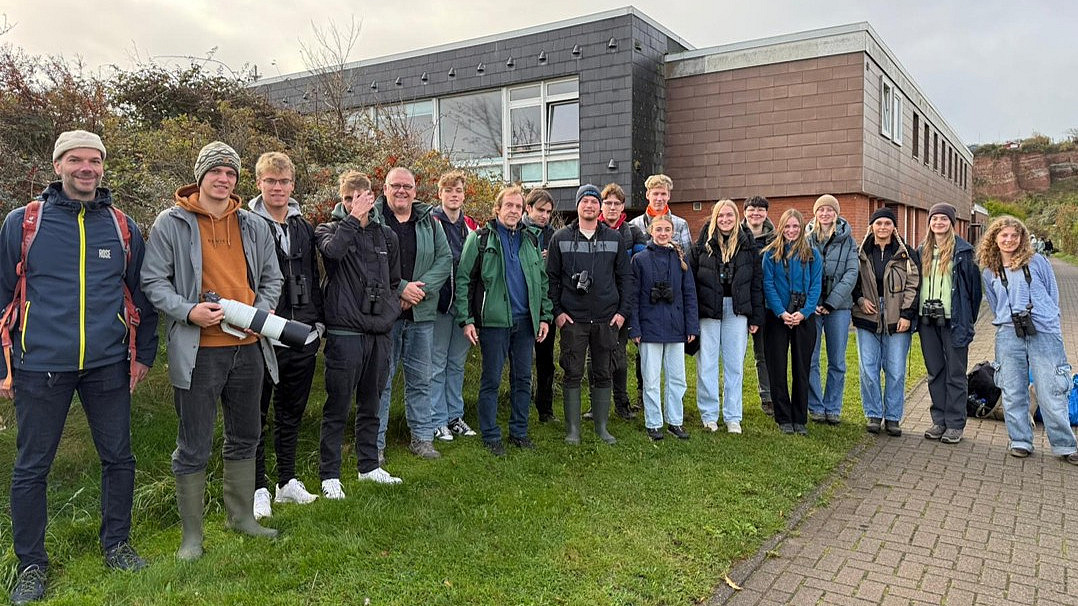
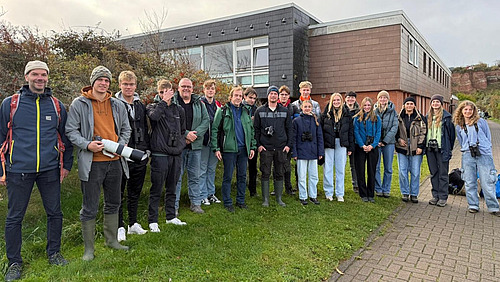
In October, the Zoology division held its annual excursion to Heligoland. The group discovered more than a hundred different species this year. Two short-eared owls and huge flocks of goldcrests caused particular excitement.

The following report by Prof. Dr. Achim Paululat, head of the Zoology division, gives an impression of the exciting insights the group gained on Heligoland.

Birdwatching at one of the most exciting spots in Europe

As part of our ‘Avifauna’ focus module, we visited the German offshore island of Heligoland in October. This meant spending almost a week birdwatching at one of Europe's most exciting bird migration spots. Every autumn, thousands of birds gather on Heligoland to take a break on their way south. This often provides an opportunity to observe well-known and rare species at close range. It is also a good opportunity to familiarise yourself with binoculars and spotting scopes and to try out identification aids, books, apps or call recognition programmes.

After the first joint observation tours on the island, the students were increasingly able to gather observation experience on their own. In the evening, all observations were discussed using photos, identifying features were discussed, and plans for the next day were coordinated. As always, we were guests at the Wilhelm-Mielck-Haus, a modern accommodation with a large group room offering a fantastic view of the sea.

Impressive flocks of tiny birds

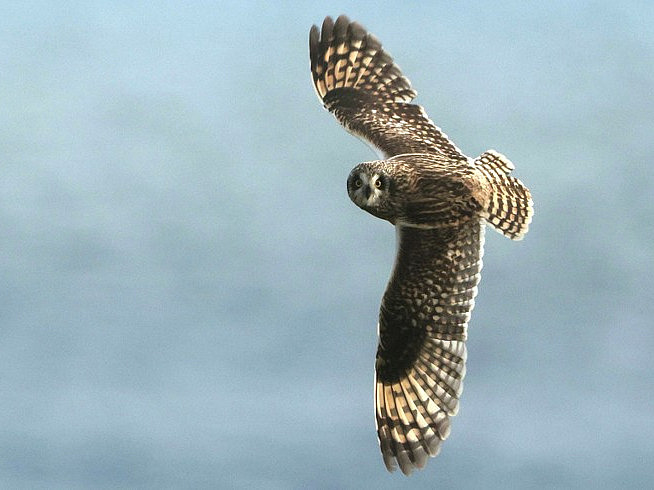
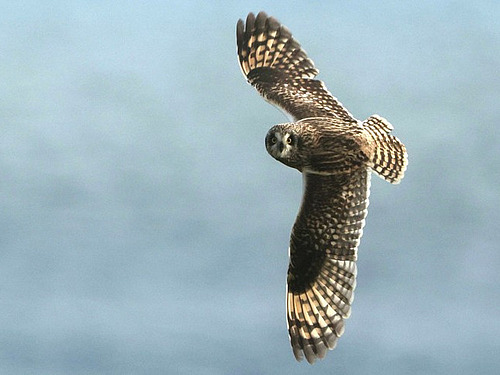
In five days, we heard, saw or observed a total of 105 bird species. Particularly impressive were the flocks of goldcrests that suddenly populated the entire island. Weighing only 5-6 grams, these birds need to rest on their energy-sapping journey to their winter quarters. Another highlight was certainly the observation of two short-eared owls in Mittelland, one of the many popular observation points on the island. It is impressive how well camouflaged these animals are. Our tutor Matthias Berger managed to capture a fantastic flight photo.
Related news

Pupils stand crowded together, with posters and information material bearing the Osnabrück University logo visible in the background.
© Niklas Kästner | Osnabrück University

Insights into the science of life: The 2025 University Information Day at the Biology department

Once again this year, the Biology department offered interested pupils exciting insights on the University Information Day with presentations, hands-on stands, taster lectures and guided tours of the Center for Cellular Nanoanalytics (CellNanOs).

View from the back of a lecture hall with students; two men can be seen behind a desk at the bottom.
© Laura Elpers | Universität Osnabrück

Start of the 2025/26 winter semester: Osnabrück Biology welcomes its new students

The start of the 2025/26 winter semester marked the beginning of biology studies at Osnabrück University for many students. We are delighted to have welcomed around 280 new Bachelor's and Master's students this year.

A speaker stands at a lectern, with people sitting on chairs in front of him.
© Niklas Kästner | Universität Osnabrück

Exciting talks and an open-air poster session: Second international symposium of Collaborative Research Centre 1557

Under the title „Plasticity of Cellular Membrane Networks“, the second symposium of the CRC 1557 took place in Osnabrück from September 3 to 5. Around 150 participants gathered at the Bohnenkamp House in the Botanical Garden for scientific exchange.

A group of people are standing in front of a building. They are all smiling at the camera
© Niklas Kästner

CellNanOs: Special workshop for experts from all over Germany

On July 21 and 22, around 25 specialists visited the state-of-the-art, interdisciplinary CellNanOs Research Center at Osnabrück University to undergo further training in the field of electron microscopy.