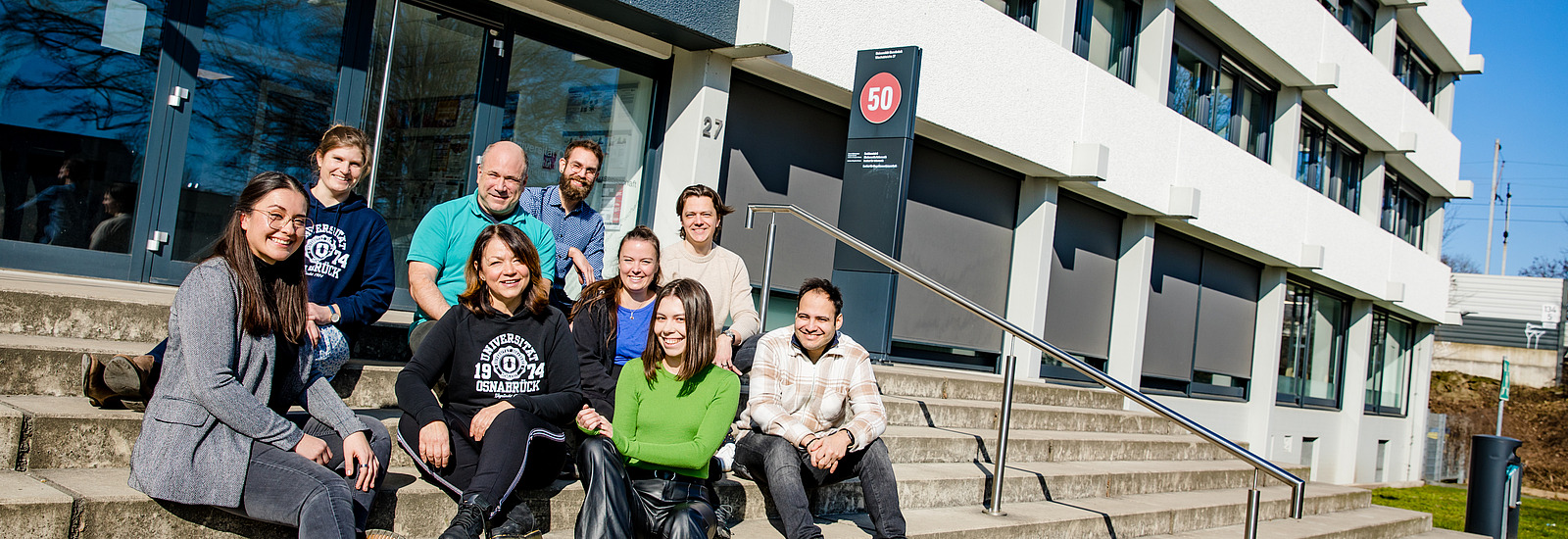
Team
Prof. Dr. Gordon Pipa

Christina Vidovic
Sekretariat
Wachsbleiche 27
49090 Osnabrück
Raum 50/217 mo-do: 09:00 -12:00
Tel: 0541-969 2390
PhD Students
Hanna Willkomm

My PhD work is part of the "MemDANCE" project, which aims to develop energy-efficient neuromorphic computing by combining memristor-based hardware with dendritic information processing in neural networks. Within this project, I’m currently inspecting how dendritic properties shape the dynamics, memory, and internal representations of self-organizing recurrent neural networks. The goal is to understand how dendritic processing can enhance robustness and efficiency in neuromorphic systems.
Tracy Sanchez Pacheco

My PhD examined how the presence and contextual congruency of human agents in large-scale immersive virtual environments influenced visual exploration, spatial navigation, and spatial memory recall. The work combined VR-based navigation tasks with eye tracking and behavioral measures, including information-theoretic analyses of gaze dynamics such as gaze transition entropy. Bayesian hierarchical models were used to relate social context and exploration patterns to spatial recall accuracy.
Viktoria Zemliak

Hendrik Wilhelm Berkemeyer

Lukas Niehaus

Lukas studied computer science in his bachelor and cognitive science in his master.
In his master thesis "Model-Based Leaf Instance Segmentation on 3D Point Clouds" he applied classical computer vision methods in combination with hyperparameter optimization algorithms to segment individual leaves.
He currently investigates the training behavior of Kolmogorov-Arnold Networks on various initialization strategies.
Laura Krieger

Laura is a PhD student working on predicting the spread of infectious diseases using Bayesian modelling. Her research focuses on how high-resolution spatial data can improve monitoring and forecasting of disease spread, such as during the COVID-19 pandemic. Prior to this project, she was involved in developing the DreamMachine, a low-cost, mobile EEG device, where she focused on software development and signal processing.