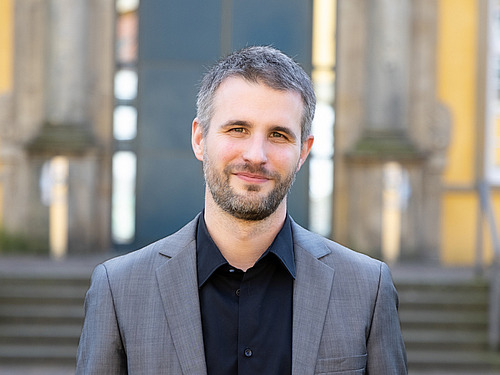
Prof. Dr. Christoph Mauntel has held the Chair of Medieval History since April 2024 and conducts research into mobility, travel and delays, among other things. A conversation about pilgrims traveling on a flat-rate basis and pre-modern waiting as part of mobility in the Middle Ages.
Prof. Mauntel, where was the last time you traveled?
I regularly commute to Osnabrück by train. Just before Christmas, I took the train to Paris for a lecture.
What would this journey have been like in the Middle Ages?
Messengers or envoys sometimes traveled on horseback. But that was expensive, as were carriages, so they mainly traveled on foot. As a result, my journey to Paris would have taken much longer!
You mentioned messengers and envoys. Who else traveled in the Middle Ages?
Society between 500 and 1500 was more mobile than we often think. It is important to differentiate between "What is travel and what is mobility?". Almost everyone was mobile, even if only in a rudimentary way. Farmers, for example, regularly had to bring taxes to the manor. Kings, on the other hand, traveled around with their court in the early and high Middle Ages, as there were no capitals at that time - in some cases, up to 1000 people traveled together. So you can go through almost all classes: Merchants moved from town to town for trade, as did those who waged war.
Did the phenomenon of "travel" change in the Middle Ages?
What particularly interests me is that longer journeys in particular became easier to plan over time. Pilgrimages, for example, became increasingly professionalized: In Venice, pilgrims could book an all-inclusive trip to Jerusalem, so to speak, including a guided tour on site, a crossing across the Mediterranean and entry documents to the Holy Land. At the same time, we see an intensification of the messenger system and in the late Middle Ages a professional postal system emerged, which meant that diplomacy could also be coordinated more effectively. It was therefore important to know where the rulers were at any given time. In the early Middle Ages, even the king may not have known where he would be in four weeks' time. More precise planning only came later.
Do you think that this ability to plan created an awareness of delays and waiting times?
My impression is that people were already sensitive to their plans and their implementation in earlier times. I tend to wonder how high the tolerance for delays and waiting times was. I think there are societies - and the Middle Ages are probably one of them - in which people lived and thrived quite well with delays. It was well known, for example, that sea voyages could not be planned precisely due to the weather. At the same time, the perception of waiting also depends on the author of a travelogue. Impatience is clearly evident in some reports.
Today, we mostly use smartphones to distract us from waiting. How did people in the Middle Ages bridge waiting times?
Envoys sent to the courts of foreign rulers are an exciting example. To a certain extent, they were professionals at waiting and used the time to network locally and implement the wishes of their patrons. However, they also knew how long a ruler was allowed to keep them waiting for an audience. The envoy of the Roman Emperor Otto I, Liutprand of Cremona, for example, described the poor treatment at the court of Constantinople in his report in 968. Not only was he kept waiting for a long time, he was literally left out in the rain. This shows that there was an awareness of how long a waiting period should actually be in relation to the social rank of the client. If this period was exceeded, the envoys became nervous or protested.
That sounds like waiting was used strategically...
Yes, this still happens today among government representatives. The person who decides when the meeting takes place has power. And we see this in the Middle Ages even across different cultures. Waiting and being kept waiting seem to have been understood in a similar way by everyone.
In the Middle Ages, just like today, extensive travel was associated with high costs. Was it already a luxury good in the Middle Ages?
According to the sources, travel in the Middle Ages was not a positive thing because it was associated with work and danger. Travelers usually reached their destinations on foot and were exposed to the weather, disease and robbers. This was not a luxury, but a risk that people wanted to avoid. This only changed in the 15th and 16th centuries, when the nobility began to travel for representational purposes. In the Middle Ages, however, being mobile was more of a duty or a risk than an expression of freedom.
Do you see this as the big difference to mobility and travel today?
Not necessarily. Certainly among financially well-off people from safe countries of origin. But even today, millions of people are on the move or on the run for reasons such as war or poverty. Here, too, there is the aspect of waiting. Refugees in Germany usually wait months or years for their asylum decision and have to bridge the gap, as they are often offered no prospects for the future. Researchers in sociology and ethnology are particularly concerned with this aspect - as are colleagues from the Osnabrück Collaborative Research Center 1604 "Production of Migration".
And then, of course, there is occupational mobility, including commuting to work. This is also a duty and not always fun.
Personal details: Prof. Dr. Christoph Mauntel has held the Chair of Medieval History at Osnabrück University since April 1, 2024. His research focuses on cartography and geographical concepts, mobility and travel as well as violence in the Middle Ages.
About the series: In the interview series "UOS asks questions", experts from Osnabrück University talk to the press office about their research and take a stand on current and everyday topics. From politics to education, from art to AI - UOS asks questions.
Further information for the media:
Prof. Dr. Christoph Mauntel
Department of History, Osnabrück University