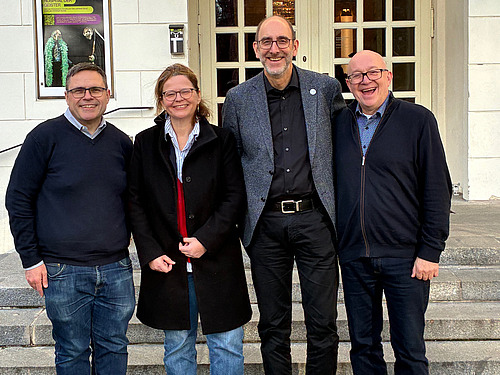
Over the next three years, an international team of literary scholars will be investigating the networking practices that the writer Heinrich von Kleist cultivated in his extensive correspondence and his innovative journalistic projects. Osnabrück University is significantly involved in this project through Prof. Dr. Elke Dubbels. Together with Prof. Dr. Seán Allan (Bonn/St Andrews), Dr. Elystan Griffiths (Birmingham) and Prof. Dr. Christian Moser (Bonn/St Andrews), she is leading the research project "'A New Regulation of Things': Social and Cultural Change in Heinrich von Kleist's Epistolary and Journalistic Networks".
The project will be funded by the British Arts and Humanities Research Council (AHRC) and the German Research Foundation (DFG) for three years from February 2026. The funding includes two postdoctoral positions - one in the UK and one in Germany - as well as an international conference to be held at the University of Birmingham in July 2027.
As early as 1805, a year before Prussia's defeat by Napoleon, Kleist spoke of a "new regulation of things" that had been triggered by the political upheavals in Europe. In the following years, Kleist reacted to these political and cultural upheavals by building up a series of networks as a journalist and editor of the art magazine Phöbus, the planned nationalist magazine Germania and the first Berlin daily newspaper, the Berliner Abendblätter. His extensive correspondence with important cultural and political figures in the German-speaking world and beyond played a central role in this.
The new research project examines Kleist's networks with a view to five key thematic areas: Politics, the military, economics, communication and transportation, and the visual arts. The aim is to explore how Kleist both made use of existing networks and created new ones. "We are particularly interested in the interferences between public communication in the periodicals and private communication in the letters as well as in semi-public spaces such as the Berlin and Dresden salons," notes Prof. Dr. Elke Dubbels from Osnabrück University.
Methodologically, the project is pursuing a new approach that focuses less on the individual author and more on collective network practices. The aim is to position Kleist's work within broader creative and intellectual networks in order to provide an analytical model for future research into the "networked" cultures of the 19th century and to move beyond paradigms of creativity that typically focus on the solitary (male) genius. "Our aim is to put authorship around 1800 into a new perspective in this way," says Dubbels.
The research results are to be published in a joint monograph entitled "Vernetzte Kreativität. Heinrich von Kleist and Napoleonic Europe". In addition, the methodological approach will be tested at an international conference entitled "A New Order of Things: Heinrich von Kleist and Napoleonic Germany" in Birmingham in July 2027, to which researchers from various disciplines will be invited. In addition, the project team intends to translate and annotate selected journalistic and epistolary texts into English for the first time on the occasion of Kleist's 250th birthday in 2027 in order to make them available to the Anglophone public in open access.
Further information for editorial offices:
Prof. Dr. Elke Dubbels
Institute of German Studies
E-mail: elke.dubbels@uni-osnabrueck.de