20/2026
Language learning assistance Osnabrück

Support for newly arrived pupils

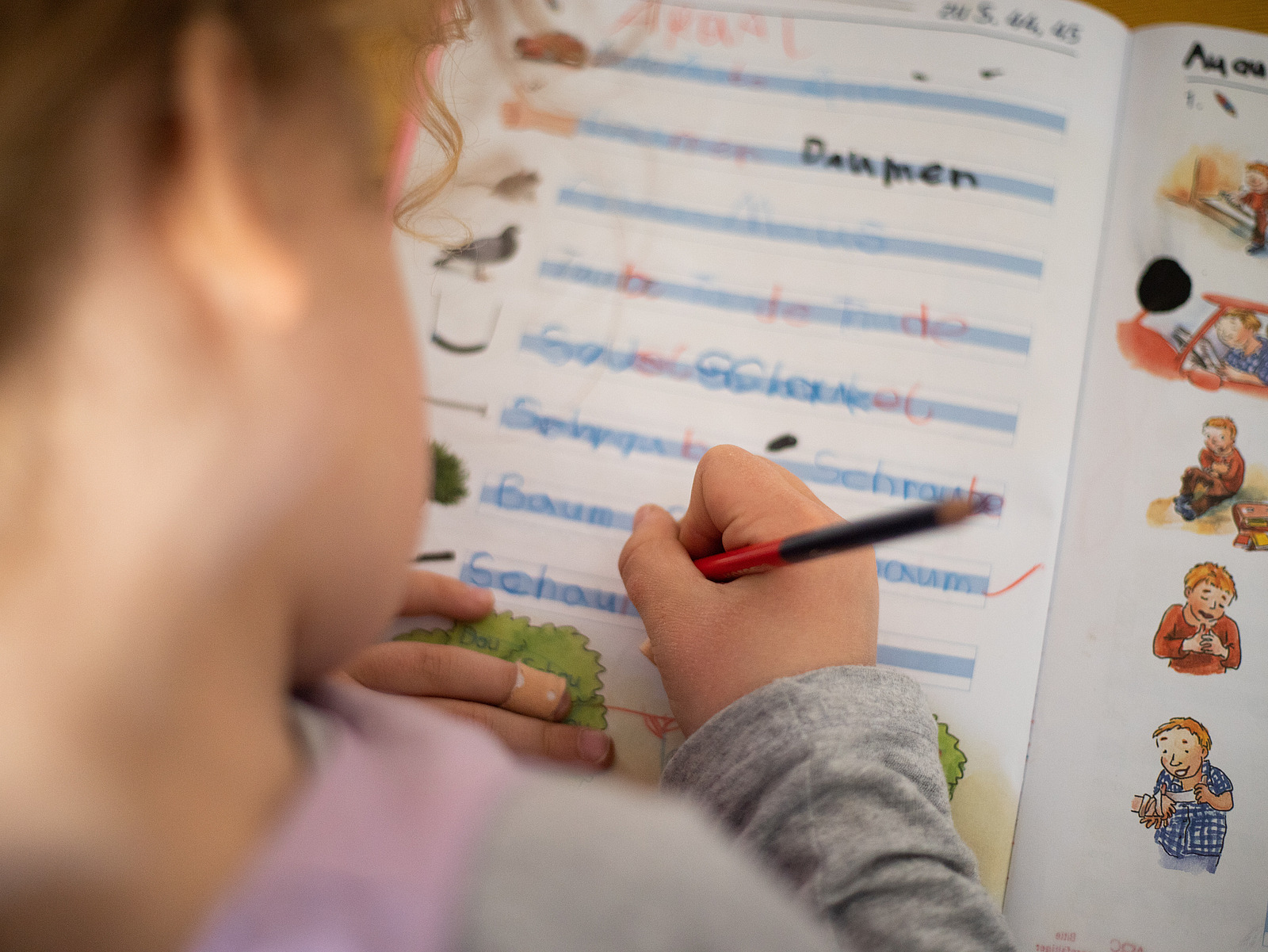
With the "Osnabrück University Language Learning Assistance", Osnabrück University is sending a strong signal for educational equality and supporting refugee children in quickly acquiring the German language.

Due to numerous violent conflicts around the world, many children and young people continue to come to Osnabrück who do not yet speak enough German to be able to participate successfully in school lessons. This makes learning and arriving in Germany even more difficult for them.

This is where the Multilingualism Research Center at Osnabrück University comes in and supports refugee children and young people in school support services to help them acquire German as quickly as possible. To this end, "Sprachlernassistenz Osnabrück" is now being continued as a service-learning project and will be funded by the Lower Saxony Ministry of Science and Culture until fall 2028.

As early as 2016, the research center was committed to the integration of schoolchildren, most of whom were refugees from Syria at the time. In recent years, a particular focus has been on supporting Ukrainian children and young people.

As part of the project, students from Osnabrück University are expanding their language skills in a preparatory block seminar. They then act as "language learning assistants" to help refugee pupils at various partner schools in the Osnabrück region to learn German. They receive professional supervision and support from experienced teachers at the schools as well as from the project team.

"Targeted language education and support is central to equal opportunities and social participation," says Prof. Dr. Katharina Nimz from Osnabrück University. "With the language learning assistance program, we are creating a bridge between the academic education of our students and the language support of children and young people who face enormous linguistic and other challenges in their new school environment due to their experiences as refugees."

More than 140 students have been active in the project so far and have been able to support newly arrived pupils both in individual settings and in the classroom context. The ninth cohort of language learning assistants is currently working in schools. Recruitment of the next cohort is planned for summer 2026.

Interested school principals and teachers from the region can find more information at:  sla-os@uos.de.

Further information for the media:
Prof. Dr. Katharina Nimz, Osnabrück University
Institute of German Studies

E-mail:  katharina.nimz@uni-osnabrueck.de
Related news

In einem modern eingerichteten Klassenzimmer sitzen kleine Schülerinnen an ihren Tischen. Die meisten Kinder haben die Hand gehoben, um an der Unterrichtsstunde teilzunehmen. Im Hintergrund steht die Lehrerin, die auf eine der Schülerinnen zeigt. Die Wand hinter ihr ist mit Lernmaterialien, Postern und Notizen dekoriert. Die Atmosphäre wirkt lebendig und engagiert, die Kinder sind aufmerksam und motiviert.
© Louis-Paul Photo - adobe.stock

New school subject "Christian religious education"

Osnabrück University is scientifically supporting the introduction of the new school subject "Christian Religious Education" in Lower Saxony and is investigating its potential for future-oriented, ecumenical education.

Portrait of a middle-aged woman in a blouse and blazer in front of a large building with many windows
© Jens Raddatz

Prof. Dr. Elke Dubbels receives award for habilitation thesis

Prof. Dubbels receives the first prize of the Geschwister Boehringer Ingelheim Foundation for the Humanities for her habilitation thesis on the literary prehistory of the debate on unreliable information and battles over public opinion.

Three women work together in a laboratory. One is sitting on a chair, another is explaining a computer graphic.
© Jens Raddatz

Research on brooding processes: When thoughts circle in a continuous loop

What is going on in the mind when negative thoughts circle and thinking seems to be stuck in a spiral? Prof. Dr. Lilian Weber from Osnabrück University is investigating this question.

neuron, brain, neurology, nerve, network, neural, biology, impulse, synapse, hormone, organism, connecting, cell, axon, system, thinking, science, energy, alzheimer, signal, medicine, neuronet, glow, microbiology, bio, macro, research, human, 3d, anatomy, biological, brainstorm, cells, connection, glowing, head, hormon, medical, mental, micro, microscopic, mind, nervous, nucleus, space, receptor, render, thought, AI, artificial
© whitehoune|adobe.stock

Tracking down the causes of Alzheimer's disease

A team led by neurobiologist Prof. Dr. Roland Brandt is investigating how harmful tau oligomers are formed - and how their formation can be specifically stopped in order to develop new therapies against Alzheimer's and related diseases.