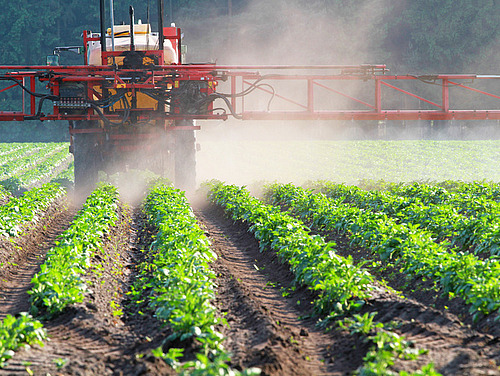
Plant protection products have become an integral part of European agriculture. However, before they are approved, they must undergo a standardized risk assessment in which potential risks to humans, animals and the environment are assessed. This assessment is based on model calculations: Predicted environmental concentrations are compared with threshold values above which harmful effects may occur. But how reliable are these models - and how complex do they have to be?
As part of the EU project PARC ("Partnership for the Assessment of Risks from Chemicals"), Osnabrück University, together with other European partner institutions, has reviewed some of the established methods of aquatic risk assessment of pesticides. Aquatic refers to environmental areas that affect bodies of water - i.e. rivers, streams, lakes and other water-bearing ecosystems. Model predictions were compared with actual measured environmental concentrations of pesticides in German water bodies adjacent to agricultural land.
The results show that simple models often predict the measured concentrations well. However, the use of more process knowledge and detailed environmental and substance descriptions does not necessarily lead to better results.
"More complexity does not automatically mean more certainty," says Prof. Dr. Andreas Focks from Osnabrück University. "Our results show that very detailed exposure models under real, highly variable environmental conditions can even lead to underestimating concentrations - and this is exactly what a regulatory risk assessment should avoid."
The study, which was carried out in the Environmental Systems Modeling working group, contributes to an improved risk assessment of pesticides. "Future revisions of the European risk assessment should take into account a comparison of model predictions with measured concentrations in order to evaluate the protective effect of the models and thus avoid the impression of a false level of safety," says Andreas Focks.
The study results were published in the renowned journal "Environment International". First author Paula Scharlach from Osnabrück University emphasizes that future models should focus on the main drivers of pollution - and not on maximum complexity. The specialist article is available at the following link: https://doi.org/10.1016/j.envint.2026.110057
Further information for the media:
Prof. Dr. Andreas Focks, Osnabrück University
Institute of Mathematics and Institute of Environmental Systems Research
E-mail: afocks@uni-osnabrueck.de