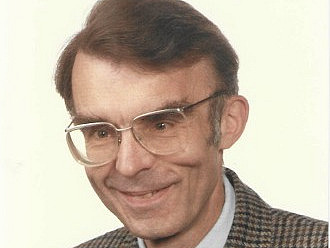
He is 87 years old and will be 88 in April. Although the English professor retired from Osnabrück University in 2003, he continues to teach, making him probably the oldest active professor at Osnabrück University. Why does he do it? "Because I learn so much in the process," he says and laughs.
Prof. Husemann's office in University Building 41 on Neuer Graben is hard to miss: British-German caricatures mark the way along the corridor and point to one of his passions - cartoons. He was private friends with the Osnabrück cartoonist Fritz Wolf, and got to know and appreciate other cartoonists during his apprenticeship. Another clue as to who you might be dealing with on the other side of the heavy green door is a drawing attached to cork: it's Paddington. With a small suitcase, red floppy hat and blue raincoat. "I love the books about Paddington Bear," says Prof. Harald Husemann. The professor of English literature also likes to answer the question about his favorite book with "Paddington".
Otherwise, he always ends up with dystopian literature that seems frighteningly contemporary: "A book like The Handmaid's Tale by Margaret Atwood - it doesn't really get more topical than that," says Harald Husemann with a view to the current world situation.
Even though the 87-year-old lives in the here and now, he looks back on the past with a sharp mind: Harald Husemann was born in Heide in Schleswig-Holstein in 1938. "My father was a staunch National Socialist and also benefited from the system as a civil servant." A picture of "our beloved Führer" hung above the sofa at home, Husemann reports dryly. It hung there until the day the German Wehrmacht surrendered - the next morning it had disappeared. "I still go around the schools in the region to report as a contemporary witness," says Husemann. And his father has also accompanied him on some of these tours.
The Osnabrück professor has also been involved in the Social Fund for Osnabrück Students e. V., or SOS for short, for 14 years. The aid organization supports students at Osnabrück University and Osnabrück University of Applied Sciences who find themselves in acute, often financial, hardship through no fault of their own. The cases keep him busy, says Husemann. He then tells his wife about it, who often says: "Why are you doing this to yourself? Why don't you stay at home?" Yes, why doesn't he just stay at home? The professor sighs heavily. "I have a problem. I don't have any hobbies at all."
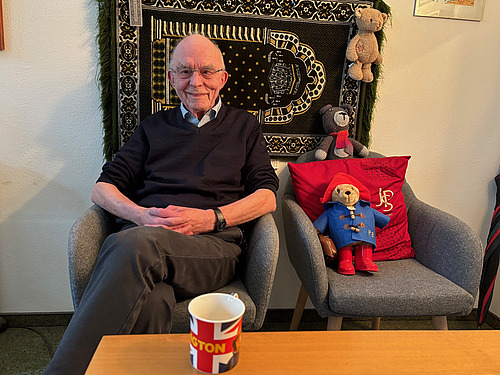
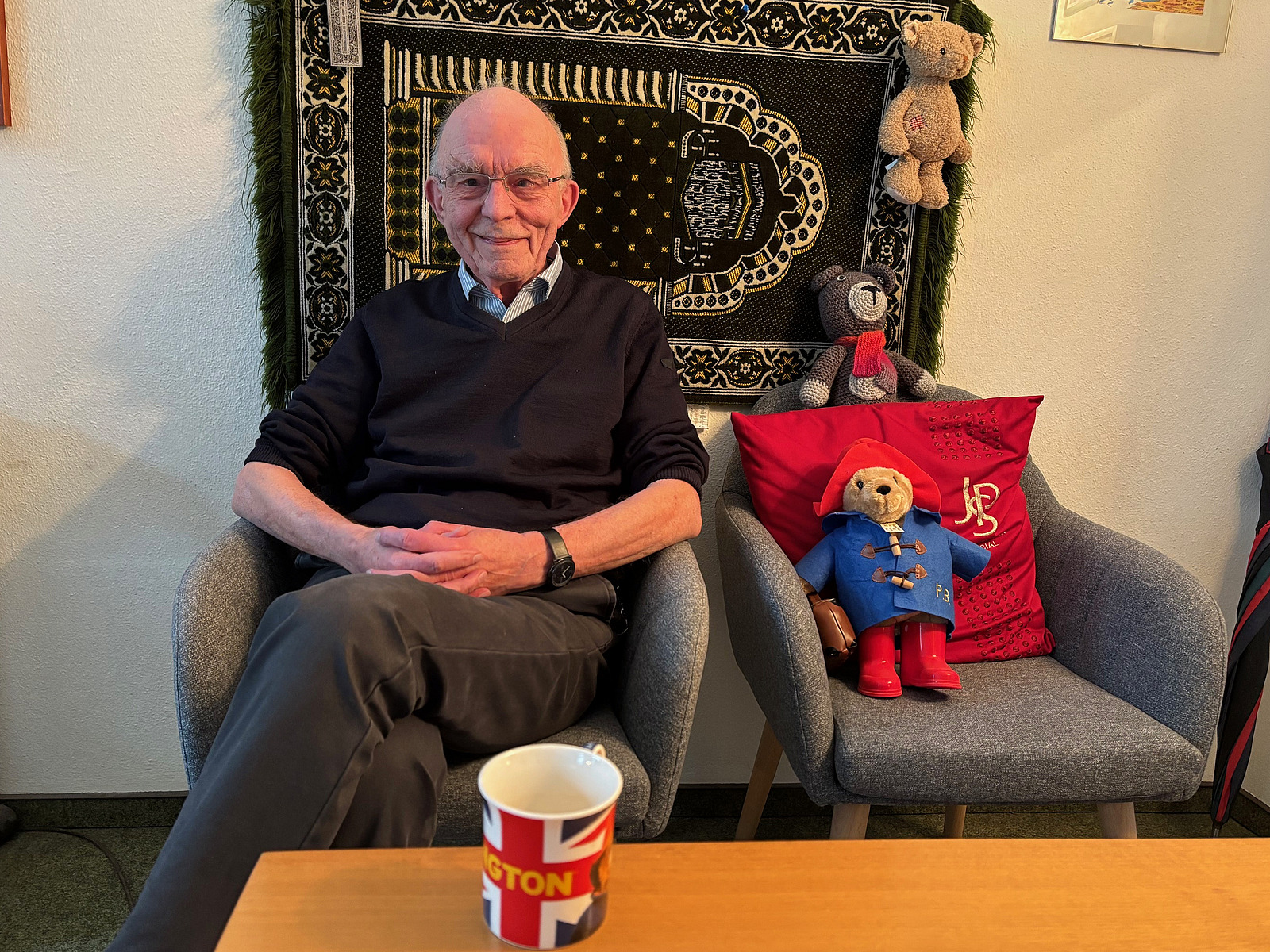
His university office is his second living room, and it looks a bit like one too: Cozy upholstered chairs with several teddy bears sitting on them, including Paddington Bear, of course. There are lots of personal items on the wall, including a caricature of Prof. Husemann himself, and there are cookies on the table that a student baked for him. "I live on coffee and cookies," says Husemann. And when his wife gets fed up with his problems, he talks about them with his best friend: the university janitor, Adolf Klein. "A man with a phenomenal sense of humor and my personal confessor," says Husemann.
After studying in Kiel and London, Harald Husemann came to Osnabrück University in 1974 and experienced the development of this young university from the very beginning. He thinks back somewhat wistfully to that time, when everything was a little freer and more informal. "There was little guidance - neither for the students nor for us lecturers." Back then, he was still allowed to smoke anywhere in the university, not just in his office or in the corridors, but even in the seminar room. He remembers a student he really liked who told him at some point that he was in his 29th semester. Today? Unthinkable. "Young people have a lot more pressure today," he says. He can't understand the accusation that today's students are less motivated than in the past.
On the contrary: he personally learns so much from his students. He owes all his digital skills to his "students", says Husemann. He also gets a lot of new ideas and perspectives from his contact with young people. "I like to make things easy for myself and simply rehash previous topics," he says with an ironic undertone. For the next semester, he is planning a seminar on Jane Austen's classics. He has already taught this in 1993. But the female view of Austen is very different today than it was back then.
Harald Husemann doesn't know how long he will continue to offer students cookies in his second living room. "My wife was an English teacher herself, and it was clear to us that once we retired, we would look for a retirement home in the south of England," says the university professor. But as life goes: "Now we've settled in. Now we don't want to leave."