Conversation, cognitive science, "Kaleidoscience": a look behind the podcast
"Find the answers to questions you may or may not have asked yourself, here at Kaleidoscience: Conversations on Cognitive Science". This is how the Kaleidoscience team introduces each new episode of their podcast. When I meet the presenters Elisa Palme and Imogen Hüsing for the interview, I have a lot of questions. Who is behind the project? What are the biggest challenges of an indie podcast? We talk about the founding idea, the work that goes into each episode, the art of scheduling – and how you can counteract a cat hair allergy with chicken eggs.
Science communication that makes an impact
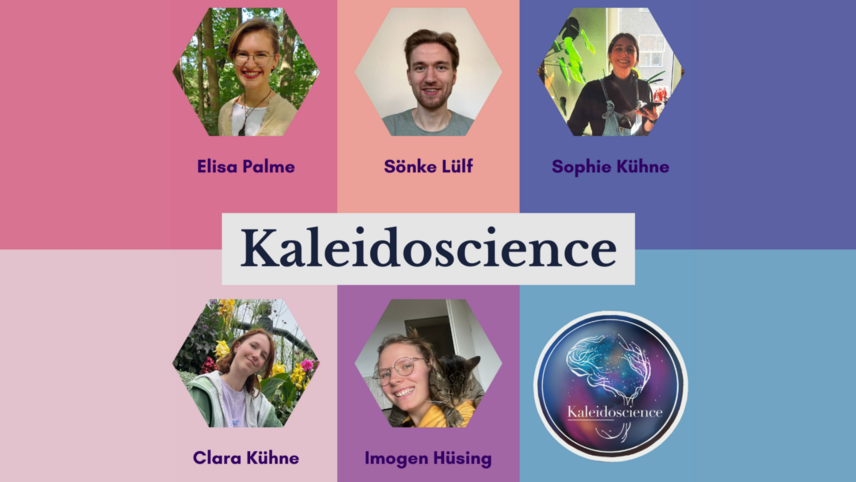
The English-language podcast "Kaleidoscience: Conversations on Cognitive Science" was launched two years ago as an initiative by students of cognitive science. In the interviews, hosts Imogen Hüsing, Sophie Kühne, Sönke Lülf and Elisa Palme talk to cognitive science experts from all over the world. How can we simulate our brain with AI? Can we get used to pain? How do gender stereotypes affect non-binary people?
After a short introductory game, the team and interview partners shed light on complex research questions in various subject areas in 60 to 90 minutes and provide insights into the minds of the researchers. With 1800 streams last year in Germany – on Spotify alone – the podcast is proof that science can also be exciting and accessible; and that all it takes for a project like this is a good idea.
An idea becomes a success
This idea already existed some time ago. Elisa laughs as she remembers the beginnings: "Three years ago, I asked Sönke if he would like to start a podcast together. He wasn't enthusiastic about it because he mainly saw the work." As a regular listener of podcasts, she wanted to do something herself with a focus on cognitive science. "I had the feeling that precisely this interface between so many fields wasn't really represented and still isn't." Sönke was also later convinced: "A year after I approached Sönke, he came back to me and asked me if we ever had a podcast idea," Elisa recalls with amusement. The team now consists of cognitive scientists Imogen, Sophie, Sönke and Elisa, as well as Clara Kühne, who, as a media studies student and social media expert, mainly takes on background tasks.
What makes it special: The podcast team does everything themselves – from researching, contacting and scheduling interviews to recording, editing and social media posting. They receive financial support from the Institute of Cognitive Science at Osnabrück University. The team specifically looks out for topics that could be of interest to a broad audience. "Each episode takes around 12 to 15 hours a week," says Elisa. Then there's the organization; a lot of work.
Although we sat down for the interview via video chat and I can only see the two of them in two video tiles, I still get a good insight into their work. The episodes are now all recorded online and no longer in the podcast studio at the university. My next question: What is the biggest challenge? "Scheduling," says Imogen without hesitation and they both laugh. As the hosts and, above all, the experts are often not in Osnabrück, not only do personal schedules have to be coordinated, but also different time zones. This makes it all the nicer that the researchers are very open to inquiries. "I have the impression that many are happy to have the opportunity to talk about their research in depth," says Imogen. She will be a permanent presenter on the podcast from the next season on. Isn't it nerve-wracking to interview top experts? They both shake their heads – they just stay cool. After all, they would be in a better position to ask questions. "Quizzing researchers about their research for an hour – that's so much fun!" says Imogen. The podcast thus offers a platform for in-depth conversations and creates an opportunity to impart knowledge and encourage reflection. The conversational nature makes the scientific topics accessible to those who don't have an in-depth background in cognitive science.
A podcast that brings science to life
At the end of the interview, I steal an idea from the podcast: At the beginning of each episode, the hosts play an introductory game with the guests and ask five personal questions. Now I want to know from Elisa and Imogen: What fascinates you the most at the moment? "Optimizing my running training," says Imogen. Very exemplary. After a moment's thought, Elisa tells me a fun fact that she heard in another podcast: If you fed the chicken eggs from your own chickens to your pet cat, antibodies would be transferred to the cat, which would affect the protein composition of its saliva. In turn, this change causes people with a cat hair allergy to react less strongly to the saliva. Absolutely amazing – and shows how fascinating scientific findings can be. With their podcast, Imogen, Sophie, Sönke, Elisa and Clara prove exactly that: science can be complex and difficult, sometimes frustrating. But above all, it arouses curiosity about the unknown, fascinates even the most skeptical people and offers insights into things that we are just beginning to fully understand for the first time. And sometimes you find answers to questions you haven't even asked yourself yet - in a podcast that brings science and the paths to it to life.
The podcast "Kaleidoscience: Conversations on Cognitive Science" can be listened to on all common podcast platforms and on the website of the Cognitive Science Student Journal. The interviews are conducted in English and require a good understanding of the language. The upcoming season will take a closer look at the topic of hormones. Among others, you can look forward to Franziska Weinmar, cognitive scientist at the University of Tübingen and host of the podcast "Let's Talk About Women"!