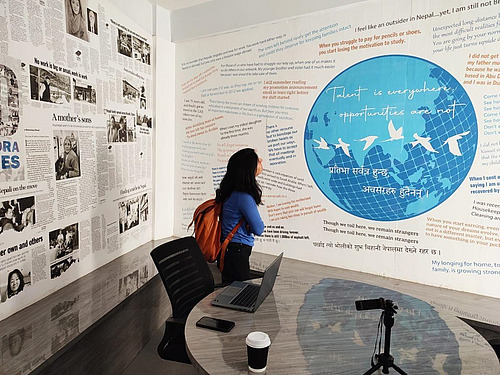
The event takes place at the Institute for Migration Research and Intercultural Studies (IMIS). Organized by doctoral students for doctoral students, the Spring School brings together 46 participants from 22 universities in 15 countries - including Argentina, Australia, India, South Africa and European countries. The Spring School is part of the DFG Collaborative Research Center "Production of Migration" (SFB 1604) based at Osnabrück University, which is dedicated to the question of how and with what consequences migration is socially produced.
Participants can expect an intensive exchange within the framework of a diverse program in which renowned international migration researchers will participate as speakers, workshop leaders and commentators. Among the highlights are the lectures by Prof. Dr. Nina Glick Schiller (University of Manchester) and Prof. Dr. Valentina Mazzucato (Maastricht University), who are among the leading voices in international migration research.
In addition to lectures, workshops, paper and poster presentations, the Spring School also offers formats beyond traditional academic settings: for example, the documentary film Derrière le soleil (Behind the Sun) will be shown in the Hasetor Cinema, followed by a discussion with Tunisian director Dhia Jerbi. Excursions to the non-profit Osnabrück association EXIL e.V. and the Baracke 35 memorial site on Landwehrstraße will also provide insights into the local practice of social negotiation processes relating to migration and create links between academia and civil society.
In terms of content, the doctoral candidates' contributions cover a broad spectrum - from labor migration and transnationalism to questions of belonging, gender and intersectionality to flight, asylum policy and civil society engagement. At a time when migration is increasingly politicized and problematized, the Spring School places particular emphasis on a reflective perspective. This is also central to the CRC "Production of Migration". Among other things, the researchers critically examine their own research practice, assumptions, methods and migration-related categories.
In cooperation with the PhD Network of the European migration research network IMISCOE, the event is also specifically dedicated to the challenges and perspectives of researchers in early career phases. In addition to questions of scientific career paths, the focus will also be on topics such as intellectual curiosity and the joy of research.
"After months of preparation, I am very much looking forward to the Spring School, to the international group of doctoral students and to the exciting discussions that will arise from this diversity of perspectives," says co-organizer Yasemin Okay, who is doing her doctorate on the production and negotiation of belonging and gender in Turkish-German mosque communities as part of the CRC 1604. Co-organizer Isabel Hoffmann, who is doing her doctorate on EU migration diplomacy in the CRC, emphasizes: "It was important to us not only to design a strong academic programme, but also to create spaces that point beyond the university and enable exchange between academia, art and civil society."
Some events - including the keynote speeches and the film screening - are open to all interested parties.
Further information for the media:
Isabel Hoffmann and Prof. Dr. Christine Lang, Osnabrück University
isabel.hoffmann@uni-osnabrueck.de and christine.lang@uni-osnabrueck.de
https://www.uni-osnabrueck.de/imis
https://www.uni-osnabrueck.de/sfb1604
Organizing team of the PhD Spring School: Can Yasemin Okay, Isabel Hoffmann, Homaira Rahnoma, Thea Kruse, Xin Wang, Prof. Dr. Christine Lang and Prof. Dr. Helen Schwenken.